


Each year, we celebrate the hard work, resilience, and crucial pipeline-driving contributions of BDRs/SDRs during BDR Appreciation Week. As part of that, we survey BDRs to understand how the role is evolving and what they’re experiencing day to day.
This year, 872 BDRs responded to our survey (490 fully complete, with partial responses included where applicable). Our sample is primarily composed of BDRs working in software and tech (70%), followed by services (23%), and manufacturing (~7%).
Throughout this report, you’ll see links to our Deep Dive edition, where you can find additional analysis and interpretation for any findings you want to explore further. More detail on the sample is also available there.
We thank all the BDRs who contribute to this research each year.
Acknowledgements
This research was co-produced by 6sense and MarketOne International. MarketOne contributed to the design, scale, and interpretation of this year’s findings. We are grateful for the partnership.
Introduction
BDRs and SDRs have long served as the initial point of contact between providers and prospective buyers — a role historically defined by volume of effort, where sustained effort was the primary currency of success. Five years into this research, that picture of how success is generated has grown considerably more complex. AI adoption has reached near-universality, quota expectations are rising at the fastest rate in five years, outreach volumes have nearly doubled, and the role’s structural position within organizations is shifting. And yet average quota attainment is statistically unchanged from last year.
That unchanged figure, though, masks a more encouraging story. Within the data, specific practices reliably predict stronger outcomes: how well organizations operationalize buying signals, whether they compensate BDRs for the behaviors they ask of them, how much autonomy reps are given, and how consistently they are equipped with quality data and tools. AI use associated with skill development — conversation analysis, role-play and simulation — is associated with better performance, while the most common application— content generation — is not. And running through all of it, for the fifth consecutive year, is the same finding that has held up across every structural shift this role has undergone: perceived job support — whether BDRs feel equipped, valued, and set up to succeed — remains the single strongest predictor of quota attainment.
The capabilities and the knowledge of what works are broadly available across the industry. What this year’s data makes clear is that the organizations seeing stronger outcomes are the ones actually putting them into practice — building the conditions where their investments in tools, training, and outreach translate into results rather than simply adding to the noise.
At a Glance
- Account prioritization tools are widely deployed but rarely drive which accounts BDRs actually work. Ninety-percent of organizations use tools that analyze buyers’ online behavior to flag accounts that are likely in an active buying process. Yet, decisions about which accounts enter a BDR’s queue are still primarily made by people — through territory assignments, marketing programs, or sales leadership. Buying signals tend to influence how outreach is conducted once an account is already in play (83%), not whether it gets worked in the first place.
- “Wrong timing” is the #1 reason prospects say no (78%) — tied with “already using a competitor”. Organizations with account prioritization tools see a lower “wrong timing” rate of 65%. Among those that have the tools and set different targets for in-market accounts, the “wrong timing” rate falls further to 44%.
- Multi-threading is near-universal — 91% of BDRs now contact multiple stakeholders within an account. Regression modeling shows that reaching two additional personas beyond the primary contact is the most effective level of multi-threading.
- 83% of BDRs receive guidance on which personas to prioritize within an account (e.g., IT, Finance, Operations). This guidance predicts ~10 additional points of quota attainment beyond the benefit of multi-threading itself.
- AI adoption is now nearly universal (99%) — up from 53% in 2024 and 62% in 2025 — yet this has not eliminated BDR jobs. Instead, headcount reductions have fallen to their lowest point in five years (8%), suggesting AI is augmenting the role, not replacing it.
- BDR reporting structure has swung back toward Marketing. After peaking at 80% reporting into Sales in 2025, the split has returned to roughly 60/40 Sales-to-Marketing — back to 2022 levels — suggesting organizations are rethinking where in the buying journey the BDR function delivers the most value.
- Quotas rose to a five-year high — 53% of organizations increased quotas in 2026, a five-year high, up from 35% in 2025. Those with increased quotas do report higher achievement, however, when Perceived Job Support is factored into the equation, the effect of raising quotas nearly disappears, suggesting that simply raising the bar is not a lever for better performance.
- Outreach volume has nearly doubled. BDRs now average ~34 outreach attempts per contact (up from ~17 in 2024 to ~21 in 2025), with AI-powered dialing tools (p=0.01) and voice agents (p=0.04) driving that volume. Cadences using these tools produce roughly 7 outreach attempts more than those not using them. However, in regression models, sheer outreach volume is not a reliable predictor of performance.
- Perceived job support is the #1 predictor of BDR performance — for the fifth consecutive year. It accounts for nearly 15% of the variation in quota attainment on its own.
- Training hours are trending downward — BDRs receive roughly half a day less training than two years ago (from ~50 hours in 2024 to ~45 in 2026) — and this matters beyond skill-building. Training directly predicts quota attainment and also shapes how supported BDRs feel: about three-quarters of its effect on performance is direct, with the remainder operating through giving BDRs the feeling that the organization invests in and supports the function (p<.001).
- BDRs who book and attend the first Sales meeting report directionally higher quota attainment than those who don’t (94% vs. 87%) — yet only about one-third (36%) complete the full handoff process, including attending themselves.
- The handoff to sales is regressing. The share of BDRs delivering prospects as fully qualified opportunities has dropped from 73% to 61%, with a growing share now passing prospects to sales as leads. This, combined with the shift back toward Marketing reporting, suggests organizations are reconsidering how much qualification should happen before sales gets involved.
- BDRs want better data, not more tools. When asked what would most help them hit their goals, BDRs consistently rank contact and account data at the top — with tools, like engagement and AI tools, ranked reliably lower. This suggests that additional layers of technology are not perceived as substitutes for foundational data; they sit downstream of it, useful only to the extent that the underlying data is accurate and actionable.
- The BDR role is not in decline — but it’s not simply progressing either. Teams are stable or growing, expectations are higher, outreach is more voluminous, and AI is everywhere. Yet average quota attainment is statistically unchanged from last year (92% vs. 89%). The core challenge is not execution capacity — BDRs are doing more than ever. It’s operationalization: the organizations seeing stronger outcomes are the ones translating their tools, data, and training into practice, not just deploying them.
BDR Teams Are Stabilizing — with Reporting Swinging Back Toward Marketing
- Cuts to BDR teams have largely subsided — only 8% of organizations report downsizing in 2026, down from roughly a quarter in prior years, with approximately 58% reporting growth and 34% maintaining headcount.
- BDR reporting has shifted meaningfully back toward Marketing in 2026 — dropping from 80% reporting into Sales in 2025 to 63% — nearly returning to the 60/40 split observed in 2022 (p<.001). This continues the pattern of the BDR function being passed back and forth between marketing and sales.
- Outbound work remains the majority but declined to approximately 70% in 2026, down from about 85% in prior years.
- The shift toward inbound is happening across both marketing and sales — inbound-focused BDRs now make up 38% of marketing-led teams (up from 27% in 2025) and 26% of sales-led teams (up from 12%).
- Hybrid work is the most common arrangement for BDRs (49%), followed closely by fully remote (34%) and fully in-person (18%) — closely mirroring broader workforce trends for remote-capable roles.

Most BDRs Are Competing for Shortlists Buyers Formed Before the First Call
- Our Buyer Experience Research (10,000+ B2B buyers) shows buyers avoid sellers until 61% of their journey, place 4 out of 5 vendors on their shortlist from day one, rank them before any sales contact, and select their first-choice vendor 8 out of 10 times — suggesting buyers are highly familiar with their options, or at least the ones they’re willing to consider.
- That same research shows ~75% of purchases are to replace, renew, or upgrade existing solutions — only ~25% represent net-new business capabilities.
- BDR data aligns: most report operating in “High Brand/Established Category” environments, meaning prospects are already familiar with both their company and solution type before being contacted.
- BDRs report prospects typically consider about 4 other competitors (4.0 for services, 3.9 for physical goods, 3.4 for software), consistent with buyer-reported shortlists of ~5 vendors.
In-Market Accounts Get the Most Outreach Attention — but Only by a Slim Margin
- 90% of BDRs report that their organization uses tools to identify accounts likely to be in an active buying process.
- Despite this, outreach only modestly favors in-market accounts.
- Only 61% of organizations set different performance targets for accounts showing signs of engagement, suggesting a lag between having account prioritization capability and fully operationalizing it.

Quota Expectations Are at a Five-Year High — but Support, Not Higher Expectations, Drives Performance
- Roughly half (53%) of BDR organizations are increasing quotas in 2026, the highest level observed in five years (previously ~35%).
- BDRs with increased quotas report higher attainment (97% versus 86% for those whose quotas stayed the same and 79% for those whose quotas decreased; p<.001), but when Perceived Job Support is factored into the equation, the effect of raising quotas nearly disappears (p=0.222), suggesting that simply raising the bar is not a lever for better performance.
- For the fifth consecutive year, perceived job support is the most reliable predictor of performance (p<.001).
- Despite rising standards, the share of BDRs who say hitting quota has become more difficult than the previous year has declined, with more now reporting that it has gotten easier.
- BDRs are more likely to report hitting quota has become easier when they have greater autonomy (p=0.027), feel more supported (p=0.013), work in organizations that set different performance expectations for in-market accounts (p=0.032), and multi-thread across two additional personas beyond their primary contact (p=0.031). Outbound BDRs are reliably less likely to report quota has gotten easier (p<.001).
- This year, the average BDR reports achieving 92% of quota attainment, statistically unchanged from 89% last year (p=0.354).

Account Assignment Is Still Driven by People
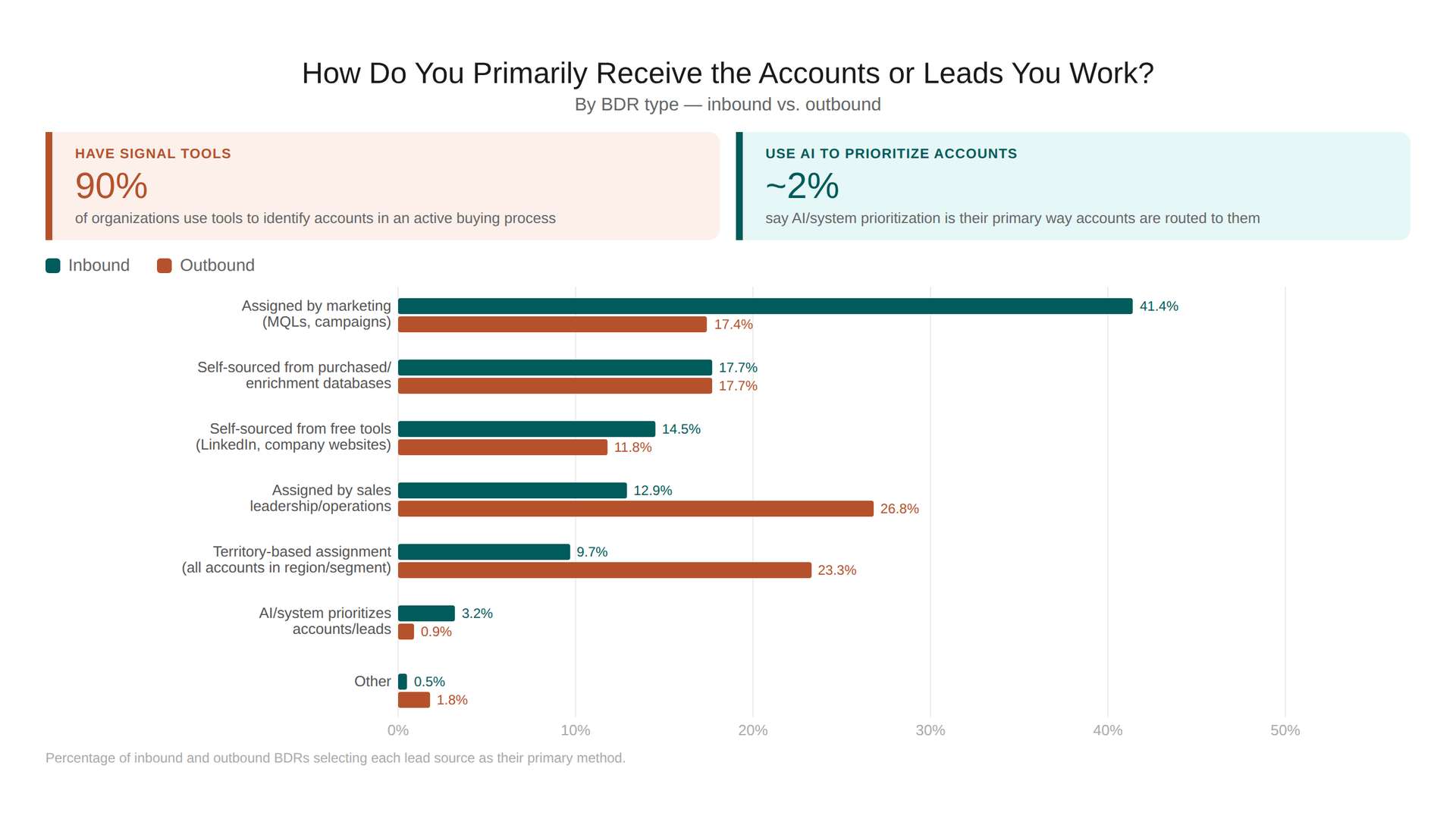
- Even though 90% of BDRs report their organization uses tools to identify in-market accounts, very few (~2%) report those systems as the primary mechanism for assigning work — decisions about which accounts enter the BDR’s queue are still primarily shaped by people.
- Inbound BDRs get a meaningfully higher share of their work through marketing-led assignments tied to campaigns or MQL programs (41.4%), whereas nearly half of outbound BDRs receive their assignments through sales leadership (26.8%) or territory-based models (23.3%).
- Nearly half (43%) of territory-based assignments prompt BDRs to begin outreach immediately upon receiving the account — with no additional buying signal required to get started.
- When accounts come through marketing programs, BDRs are more likely to wait for some sign of buyer activity before reaching out — either flagged by a system (32%) or interpreted by a person (38%).
- BDRs working from purchased or enrichment databases are most likely to rely on system-generated signals like intent data or engagement scores (38%) to decide when to begin outreach — more so than in any other model.
Buying-Stage Signals Influence How BDRs Engage — but Rarely Who They Target or When They Start
- 90% of BDRs have access to tools that identify in-market accounts. Among those, 61% say their organization sets different performance targets for accounts showing signs of engagement vs. those that do not.
- 83% of BDRs say their outreach strategy differs depending on whether a buyer appears to be early or late in their buying process — suggesting that while buying stage signals rarely determine which accounts get worked (~2%) or when outreach begins (~19%), they do appear to shape how BDRs engage once they’re in motion.
- BDRs who adjust outreach by buying stage tend to offer things like personalized videos, customer references, virtual events, and educational content more frequently than those using a uniform approach – positioning outreach as a source of value rather than purely a meeting request.
Having the Tools Is Not the Same as Using Them
How signal data is — and isn’t — used across the prospecting workflow
Access
Have access to account prioritization / signal tools
90%
↓ But how are signals actually used?
Routing
To determine which accounts to work
Signals drive account assignment
2%
Triggering
To decide when to begin outreach
Signals trigger the start of a cadence
19%
↓ Once already working an account…
Strategy
To adjust outreach based on buying stage
Early vs. late stage shapes how BDRs engage
83%
Signal data shapes how BDRs engage once in motion — but rarely determines which accounts get worked or when outreach begins.
Among BDRs with access to account prioritization tools (90% of sample).
Outreach Volume Has Nearly Doubled
- The total number of touches BDRs deliver to each contact has increased substantially, rising from approximately 17 touches in 2024 to ~21 in 2025 and now to ~34 in 2026. Increases are statistically reliable across all channels (p<.001).
- A linear regression model explains nearly half the variance in cadence intensity (R²=48.3%, p<.001), with four factors driving most of it: AI-enabled outreach tools, inbound vs. outbound motion, offering type, and the market position (brand/category awareness) of what’s being sold offering.
- Email outreach has increased to 12.3 touches per contact, up from 8.5 in 2025 and 6.5 in 2024.
- Call activity has increased to 12.2 touches per contact, up from 8 in 2025 and 6 in 2024.
- Social outreach has grown most sharply, reaching 10 touches per contact, more than doubling from 4.5 in prior years.
- BDRs using AI-powered dialing tools or voice agents deliver cadences that are approximately 7 touches higher than those who do not (AI-powered dialing: p=0.01; voice agents: p=0.04).
- Inbound BDRs consistently deliver more touches per contact than outbound BDRs (p=.05).
- BDRs selling physical goods report the highest outreach intensity, with substantially larger cadences than those selling software/SaaS (p<.001) or services (p=.02).
- Higher-priced solutions are directionally associated with more touches per contact, though the relationship falls just short of statistical significance at the 95% level (p=0.07).
- BDRs representing vendors with low brand recognition in established categories deliver fewer touches per contact.
- The source of the account or lead (marketing, sales assignment, territory, or self-sourced) does not meaningfully affect how many touches are delivered.
- Multi-threading behavior does not meaningfully change how intensively any single contact is pursued.
- The pace of outreach is highly consistent across all BDRs, averaging 4 to 5 touches per week regardless of role or industry, meaning that contacts are typically engaged nearly every working day for extended periods.
- Differences in total outreach volume are driven primarily by how long cadences are sustained.
How Long Do BDRs Pursue a Contact Before Moving On?
Duration of outreach cadence by offering type
Bar length represents months of pursuit. Badges show total touches and pace per week.
Multi-Threading Is Near-Universal — Guided Persona Prioritization and Incentives Influence How Effectively
- In 2026, 91% of BDRs report reaching out to multiple stakeholders within an account, statistically the same as last year (90%) but up from 83% in 2024.
- Outreach commonly spans 9 to 15 individual contacts per account depending on offering type and whether the motion is inbound or outbound, with each contact receiving outreach nearly every working day for 6 weeks to nearly 3 months.
- 62% deliver the same number of touches to additional stakeholders, 24% deliver fewer, and 15% deliver more.
- 83% of BDRs receive guidance on which personas to prioritize within an account (e.g., IT, Finance, Operations). This guidance predicts ~10 additional points of quota attainment beyond the benefit of multi-threading itself.
- Two-thirds (66%) of BDR organizations reward multi-threading in compensation or performance evaluations — and it shows. Those in orgs that explicitly recognize and reward multithreading reach ~12 individual contacts per account vs. ~9 in those that don’t (p<.001), and report meaningfully higher job support scores.

Only ~1 in 4 Prospects Contacted Attend a Meeting — with Channel Effectiveness Varying by Motion
- Out of every 100 prospects contacted, BDRs report an average of 41 respond in some way (answer a call or reply to a message), roughly 33 of those turn into a meaningful conversation, and about 23 ultimately attend a scheduled meeting.
- For inbound BDRs, email is the top-performing channel for generating responses (55%), while outbound BDRs show less consensus, with phone and email running nearly even — 40% and 36% respectively — as the top-performing channel.
- Social channels like LinkedIn are the lowest-performing for both groups, with fewer than 10% of BDRs — inbound or outbound — identifying them as their best channel for generating responses.

The Handoff to Sales Is Regressing — Fewer Prospects Are Being Passed as Qualified Opportunities
- In 2026:
- Approximately 61% of BDRs pass prospects as opportunities
- Around 32% pass prospects as leads
- Last year, closer to 75% of prospects were passed as opportunities, indicating:
- A loosening of qualification standards, or
- A greater willingness to pass earlier-stage prospects to sales
- Only 36% of BDRs report completing a full handoff sequence — qualifying, providing notes to sales, booking the meeting, and attending it themselves.
- BDRs who attend meetings report directionally higher quota attainment than those who do not (p=0.172 — directional, not statistically reliable):
- Those who attend meetings report approximately 94% quota attainment compared to 87% among those who give Sales notes or background but do not book the first meeting.

What Reliably Predicts BDR Performance — and What Doesn’t
- For the fifth consecutive year, the most reliable predictor of BDR performance is how supported BDRs feel in their roles.
- On its own, perceived job support explains nearly 15% of the variation in quota attainment.
- In addition to job support, several factors show consistent relationships with higher quota attainment. These are variables where increases are associated with higher performance:
- Time spent actively contacting prospects
- Number of training hours received
- Number of tools provided to BDRs
- Number of contacts reached per account
- Multi-threading was also a reliable predictor of performance, with reaching two additional personas being the most effective level (p=0.04).
- Sheer outreach volume is not a reliable predictor of performance (p=.510).

Tool Access Is Broad, but Training Hours Are Declining and BDRs Want Better Data Above All Else
- 72% of BDRs report access to data enrichment tools
- 71% report access to sales engagement platforms
- 68% report access to intelligence platforms
- On average, BDRs report having access to two of the three tools above. Adoption rates across all three are statistically indistinguishable from one another (p=0.143).
- Fewer than 2% of BDRs report having access to none of them.
- Average training hours have continued to trend downward, from approximately 49 hours in 2024 to 47 in 2025 to 45 in 2026 — a direction that is consistent but has not yet reached statistical significance (F=1.77, p=0.172).
- Mediation analysis tells us that about three quarters (73%) of training’s effect on performance is direct, with the remaining quarter (27%) operating through the support it signals to BDRs (p<.001, z=4.441).
- When asked what would most help them hit their goals, BDRs consistently rank contact and account data at the top — with tools, like engagement and AI tools, ranked reliably lower. This suggests that additional layers of technology are not perceived as substitutes for foundational data; they sit downstream of it, useful only to the extent that the underlying data is accurate and actionable.

Most Organizations Capture Why Prospects Say No — but a Third Rarely Use It
- In 2026, approximately 95% of organizations report capturing negative disposition data.
- Many organizations (60%) say they use that feedback to improve targeting, and a meaningful share report rarely acting on or analyzing it (35%).
- “Already using a competitor” and “wrong timing / not a priority” are statistically tied as the most common reasons prospects say no.
- Among organizations with account prioritization tools but no differentiated targets for in-market accounts, the “wrong timing” rate falls to 65%. Among those that have the tools and set differentiated targets, it falls further to 44%.

AI Adoption Is Now Universal — but the Highest-Performance Uses Aren’t Yet the Most Common
- AI adoption among BDR teams has accelerated rapidly over the past three years:
- 53% in 2024
- 62% in 2025
- 99% in 2026
- Most BDRs are not waiting for their organizations to provide AI tools. Only 27% rely exclusively on company-provided tools, while 35% use personal tools only (ChatGPT, Claude, etc.) and 36% use both.
- Among organizations where personal AI use is occurring, 42% actively encourage it, 30% are aware but have taken no position, 23% discourage or restrict it, and 5% appear unaware it is happening at all.
- The share of BDRs who say AI makes them more productive grew from 62% in 2025 to 72% in 2026, while those saying it is “not yet meaningful” dropped from ~25% to 15% — a consistent 13% still view AI as a threat to the role.
- The most widely adopted use of AI is producing messages and content (74% of AI users), followed by reviewing and analyzing conversations (62%), automated outreach to prospects (37%), and account identification and prioritization (35%).
- Content production — the most widely used application — and automated outreach are not reliably associated with increases in quota attainment.
- Reviewing and analyzing conversations (role-play, call simulation, etc.), on the other hand, is reliably associated with increases in quota attainment. Account identification and prioritization also shows a directional advantage but falls just short of statistical significance.
AI Adoption Has Reached Near-Universality
Each dot represents 1% of BDRs surveyed
53%
of BDRs reported using AI tools in 2024
Based on BDR self-report of AI tool use in their role.
Perceived Job Support Remains the Strongest Performance Predictor
- Perceived job support — measured across four dimensions (knowing what's expected, having the tools to do the job, feeling the role is valued by leadership, and believing the role supports career growth) — has stabilized after reaching its lowest point in 2024, though it has not returned to the highs of 2022.
- For the fifth consecutive year, perceived job support is the most reliable predictor of BDR performance. BDRs who feel well-supported achieve nearly 23 percentage points higher quota attainment than those who do not (~100%versus 77%). (p<.001).
- A regression analysis predicting BDRs' sense of support explained roughly 40% of the variance in support scores (Adjusted R²=0.383, F (19,310) =11.74, p<.001), and points to several concrete actions organizations can take to strengthen it (see table below).
Organizational Predictors of BDR Support
| Survey Item | What It Means | What Leaders Can Do |
|---|---|---|
| Negative Disposition Capture | Organizational responsiveness — reps feel their experience shapes strategy | Systematically collect reasons prospects decline and visibly use that data to refine targeting and messaging |
| Compensation for Multi-threading | Alignment between what's asked and what's rewarded / organizational integrity | Audit whether your compensation and evaluation criteria actually reflect the behaviors you ask BDRs to perform |
| AI Tools | Organizational investment in keeping reps equipped for the modern job | Provide company-sanctioned AI tools so reps aren't relying on personal tools alone — those with access to both report higher support than those with only personal tools |
| Tools Quantity & Quality | Being set up to succeed / feeling resourced | Expand the tech stack where possible, but also audit whether existing tools are delivering reliable, usable data |
| Autonomy | Trust and belief in reps' judgment | Give BDRs flexibility over outreach timing and messaging rather than prescribing every element of their approach |
| Buying Role Clarity | Being treated as an informed partner, not just a pipeline generator | Invest in persona training so BDRs understand the context and significance of who they're engaging with |
| Sales Handoff Involvement | Seeing where their work leads / feeling like a participant in the full revenue process | Give BDRs visibility into what happens after handoff and involve them in the steps that follow a qualified prospect being passed to sales |
| Training | Signal of organizational investment in rep development — 73% of training's effect on performance is direct, with 27% operating through the support signal it sends to reps | Prioritize consistent training — the message it sends about organizational commitment matters as much as the skills it builds |
Each factor in this table was identified as a significant predictor of BDR support in a regression model accounting for a broad range of organizational and role-level variables (Adjusted R²=0.383, p<.001). The "What it means" column reflects the broader psychological dynamic each finding points to.
Future Career Aspirations
- In 2026, 53% of BDRs report that they hope to move into a sales role, statistically unchanged from 59% last year.
- Beyond sales, smaller but consistent portions of BDRs report interest in adjacent functions:
- 21% aim to move into customer success (19% last year)
- 14% aim to move into marketing (10% last year).
Implications for BDRs in 2026
The BDR role in 2026 is not in decline — teams are growing, headcount reductions are at a five-year low, and BDRs themselves remain largely optimistic about where the role takes their careers. But stability at the aggregate level should not be mistaken for progress. Expectations are rising faster than outcomes, and the gap between what organizations are investing in the role and what they are getting back from it points to something worth taking seriously.
Much of what drives that gap comes down to operationalization. The intelligence exists to identify which accounts are in an active buying process — 90% of organizations have access to it — but only 2% of BDRs say it actually determines which accounts they work. AI is nearly universal, but the applications most associated with better performance are not the ones most BDRs are using. The practices that predict support — and through support, performance — are well documented at this point. Closing the feedback loop on why prospects say no, aligning compensation with expected behaviors, giving BDRs autonomy and genuine visibility into the sales process they are contributing to — these are not new ideas. They are just not yet standard practice.
For leaders, the implication is less about what to add and more about what to follow through on. The organizations seeing stronger outcomes are not necessarily those with the most tools or the highest quotas — they are the ones where the capabilities they have invested in are actually shaping how their teams work. That gap between having something and using it well is where most of the performance opportunity in this industry currently sits.
Keep Reading
