


If you like variety, unpredictability, if you wanna push boundaries, those are all good indications that you would thrive in a challenger brand. If you like predictability, if you like things to be quite structured, it may be more challenging to thrive in a challenger brand. This is Revenue Makers, the podcast by six cents investigating successful revenue strategies that pushed companies ahead. Hey, Sanna. So do you like a good underdog story? I love a good underdog story. What’s your favorite underdog movie? I would say Rudy. I guess everyone probably knows that movie. That’s a pretty good one. Well, we don’t have an underdog story as much as we have the concept of underdogs in marketing and in business, sort of, I guess we could say. But we have a great guest today, Lauren Berkmeyer. She is the CMO of Ulife, which is a really interesting company seriously disrupting the insurance space. Yeah. And she’s got an interesting background. Right? Tell us. She actually was media, Wall Street Journal and Dow Jones, and then made the transition into working for one or two other health care organizations as well and then landed at Ulife about it was five years ago or so. And she’s a, you know, an American marketer living in London which is always another fun part. Love it. It was an interesting conversation. I think the listeners will get some really cool sort of tips around what it means obviously to be a Challenger brand and how you build up your team and the DNA of the team when you are really embracing that mindset, how you invest in your programs based on that, and how you take advantage of your ecosystem. So really tangible tips to take away regardless of whether you are in a similar situation or you just wanna see how the how it works. In a really good sense, if you’re actually looking at potentially joining a company that qualifies as a challenger and what to think about and what you really want in your career that could align or not align in terms of what what works for you in an organization. So really great chat. Let’s jump in. Let’s do it. Lauren, thanks so much for joining us. Really excited to chat today about this particular topic. But before we start, we know who you are. We know your name. But rather the company you’re at now because I think the industry and what you’re doing is a perfect setup for the topic of challenger brands. Yeah. A pleasure to be here too. So Lauren Birkmeyer. I’m chief marketing officer of Ulife. So I joined Ulife about five years ago following the founder’s mission of creating life insurance that inspires life, which is sounds like a bit of an oxymoron, and a challenger mission statement. Big mission to improve the world and drive more value out of your insurance. And so we do that with a great piece of tech that incentivizes and gamifies and rewards healthy behavior. And so, effectively, we’re disrupting the group life and group health insurance market by partnering with the best insurers in the world, like a MetLife and a BUPA, but then creating this experience that is really driving tremendous value to both the business and an employee and getting people healthy in the process. So I would say quite a rewarding and challenging mission to work on, and it seems to be doing quite well. So Today’s topic is challenger brands. How would you define what is a challenger brand? Yeah. I think for me, challenger brand is it’s a mentality, and it’s setting a mission that is essentially evoking a way for people to think differently about a product’s role in the world. And it’s doing that with authenticity and clarity and disruption and a new approach and very much, I think, on a brand level and a product level. So just thinking about, you know, the world is advancing at rapid pace, and, essentially, everything is evolving every single day. And so challenger brands are really those that are evolving and creating new mechanisms to deliver a core product in a more effective way. How do you get your mind into that world? Because it’s sort of you’re admitting you’re the underdog. You’re saying, you know what? We’re we’re coming in. But what is that mindset of a challenger, Brian? How do you get yourself in that space? It can be particularly tricky when an industry that you’re challenging is hundreds of years old. Right? And so the way in which they’ve operated and thought about the service and the value it delivers has been the same for a very long time. And so what you do need to think about is there’s obviously a natural creativity involved with how you identify, like, what do people really want? Interestingly, when I think about insurance, like, insurance was designed to protect people from harm. Right? But it wasn’t necessarily it was designed to be quite reactive. And as the world has evolved, people will think differently. They actually don’t think about just reacting to something. They think about how do I proactively this is every growth mindset. How do I proactively get ahead of the problem? And so I think for many years, insurance didn’t necessarily feel it had a role to play in that ecosystem, and the tides have turned. And so, you know, probably about twenty years ago, I think, you know, a lot more health insurers, life insurers, you know, start thinking about, okay, how do we add in some tools that actually help people live better lives? But they were still very much looking on that, you know, helping sick people. So I think for us, it was really evolving the value chain, and that’s what a lot of challengers have done is they’ve looked at the value chain of what a product delivers and how do you make it even more valued? Because, essentially, people don’t buy things they don’t value. You know, times are really over where it’s very transactional in many products. There’s always definitely a layer of value, whether that’s the technology capabilities or the service delivery. So I think it’s really looking at that broadening value chain. No. I feel like there’s so many places we can go in this specific conversation as you’re working with a marketing team. And how do you even create that DNA of the team to be a challenger and to be disruptive, and then how that infect affects your investments and your budget and where you spend. So maybe we’ll tackle both of them, but let’s start with just how you hire, recruit, and really create that culture within your organization as the CMO to, like, fulfill that promise. It’s interesting because entrepreneurial spirit and challenging brand kind of work hand in hand. And so, you know, some of the characteristics that I look for in terms of like, being curious, being open to take risks, being very agile and adaptable, all these things that you actually want in a startup, you want in a marketing team in the terms of how you look at your brand and how you connect with your audiences. There’s a real mentality that comes from being a strong and an amazing marketer who then their strengths will really shine in a challenger brand because they are looking to really kinda take risks and approach things in a different way that necessarily weren’t always being done. Now with that said, you have to stay true to your core mission and your values and really leverage what has been established foundationally from the beginning, and that has to feel authentic and resonate with your audiences too. I love initiative. You know, it’s interesting. We talk a lot about being proactive with your health. Like, being proactive every day as a marketeer, but also challenging the way you do things every day also results in being a very effective challenger brand. So it all kinda intersects. Brand’s gotta be paramount, more important than the product, the offering itself. How do you approach that? Because you mentioned them in terms of hiring, but also how do you think about the brand day in, day out? Early on, for us, it was really about, like, bringing color to this black and white world. And how do you then do that not only through your product, which is very colorful, but also through the way you’re represented? And to me, color is not just about, like, the shirt I’m wearing, which, by the way, is their brand t shirt tie dye. It’s not just about the t shirt and the, you know, the tie dye that you’re wearing, but it’s the color you bring into the stories you tell about how you’re impacting people’s lives. It’s the depth that you share in terms of, like, really, like, that value and how you’re impacting people and how that mission actually transcends beyond just a statement to actually, like, real life. So we do lots of storytelling, but I think, interestingly, the real stories convey how much of a challenger brand we actually are because those stories never existed until we came to the party and said, you know, let’s actually drive an experience people are using and engaging and loving every day because they’re getting rewarded for everyday activity and these micro habits. And ultimately, then they feel much better about their insurance and the program that their employers are buying for them. So So it’s a real win win from that regard. Yeah. You’ve been a CMO before. Are you thinking about how you’re allocating your budget to branch differently in this environment versus, you know, in a maybe in a more established market? Or Yeah. You know, we had this I was at a conference this week, and, you know, everyone loves a bit of percentages. And the consistent percentage was sixty percent demand gen, forty percent brand. To me, that’s very binary. I don’t spend as as much on brand, but I do a lot. If I talked about brand and man man hours and people representing Ulife and sharing the love and all the activity that our founders do on LinkedIn and all of the organic stories that are being shared by customers, that’s all incredible brand advocacy, which doesn’t have a cost. So I put a lot of fuel in the engine of organic social proof, which helps elevate your challenge your brand status and drive cred. But then I also think, okay, I need top of the funnel. Ninety five percent of our buyers are not you guys know this very well, are not shopping for your product. You need to make them shine, and you need to know what resonates with them. So we look at, like, a lot of digital marketing activity to be able to share those stories so people connect. But it’s all about storytelling. It’s all about, like, the practicality of how you can drive value to your employees and win for the business. And that really seems to resonate. So I’d say not a straightforward answer, but I hold them equally important, you know, the MQLs and the brand activity, but I also don’t feel like it’s a fair representation to just look at the budget associated to them. It’s a great point. And you said binary. And we had we had an episode a few weeks back about brand to demand. And you can say, like, you’re spending x here and y there, but that brand spend is demand spend. That demand spend, you know, it’s like we could debate that all day long. Also, like, we I love a bit of attribution modeling. It sounds dorky, but I like to be able to say it’s not all all about marketing originated deals. It’s all about the journey to get to the win. So we’re looking at influence all the time. And that influence is not, you know, high intent, low funnel. That influence is people are, like, engaging in events and ebooks and various pieces of content to go through a journey that then they actually wanna buy when they’re ready. Well, if that’s dorky to you, you’ve come to the right place. So I’m talking about attribution modeling and so forth. But I know. I know. It’s your bread and butter. Secret sauce. I love everything you’re saying in particular about going beyond just traditional brand investments and leaning in on this advocacy and the broader story. So much of that is what brings credibility, particularly when you are the challenger brand. Can you talk a little bit more about how you cultivate that that credibility with your customers and with prospects, frankly, who, you know, see you as something new, but something new isn’t always as trusted. One of my OKRs I set from the beginning was establish Ulife as a credible group insurance provider of the future. How do you do that? So this is a industry that is, like, I would say quite skeptical, essentially. But also, we weren’t creating insurance. We’re creating a new way to deliver an insurance program with technology at the forefront of that, but we weren’t creating a new insurance product. So, you know, we were partnering with the MetLife. We were partnering with Bupa. So this is where partnership is so key. You have to leverage your partners who are best in class at what they’ve done for a long time, and they’re the safe pair of hands. And then you have to drive the education of why to think differently about the insurance you’re delivering to your teams. So I would say the way that we drove that education and drove that credibility and thinking differently about this insurance model was through those stories, was the fact that the product is working. The metrics are showing levels of engagement that are Duolingo territory. So I think it’s one thing to say, let’s play a game, and let’s make everyone healthy, and this is an amazing new experience. But if the product doesn’t deliver what you’re saying on the tin, you lose the trust and credibility. So it became a multiplier effect. And interestingly, like with anything, with any challenger brand, social proof does wonders. Individuals like to follow what’s new best in class. Right? And so I would say it became this sort of cyclical where we’re still doing loads of storytelling to be able to trigger the retail industry, to be able to trigger the new tech startups and show them actually, like, we can drive culture, we can drive employee engagement and well-being, and and this is how. I would say you need that core based customers to then get those metrics and be able to then demonstrate. I say this in university, the reason to believe. We had an entrepreneur teacher who said the three rules of marketing physics was that the product had to have an overt benefit, be dramatically different, and have a reason to believe. It’s how a lot of infomercials are based. So I think that always sticks in my head in the background, and I’m like, you know, a lot of that is comes down to the data to prove as well. There has to be when going into the the large organizations insurance. They’re like, what am I doing? Like, I’ve been buying the same type of insurance for seven thousand years. This unwillingness to a change, I would imagine you probably get a lot. How do you fight that? What’s the best way to get through it? You know the phrase, don’t boil the ocean. I always say, like, one in four people are ripe for your life. Great. Find those people. I don’t need to convince the entire world, and especially it’s not efficient from a budget perspective, that they need to change their mentality. But if you find those change agents and those people looking to do something different, and there’s a lot of triggers. There’s a lot of data points that you can find those individuals and that fish for the right fish. It’s interesting. There’s different criteria, and it varies by advisers too. So, like, we work with a lot of intermediaries. The advisors who love and thrive on consulting with their customers and driving value, we do great with them. And there are some advisors who are like, I sell what I’ve always sold the last twenty years, and that’s okay. And so you don’t wanna push too big of a boulder up a hill. But equally, you wanna find those customers that really connect to what you’re you’re selling. And those are the ones those are the best customers to get anyway, and that’s where you drive the most value. Know your ICP. Love it. Your ICP. Yeah. It comes up in every episode, FYI. Lauren, this has been fascinating. We love your approach, love the positivity, by the way, the color that you’re bringing. We ask every guest this question. What is the most ridiculous thing that you have been asked to do in your career? This takes me back. It’s okay if it’s, like, twenty years from now. Yep. Beginning of career, right out of university, I co produced a comedy variety show. And I was charged with not only, like, managing the comedians and helping pay them and fill the theater of a thousand people every week, but hiring circus o l a type talent. So I had big casting calls to find, in a sea of a lot of people, still walkers and Amazonian type fake people who were incredibly tall to just create this real circus comedy experience. And there’s a lot more stories behind that, but I’ll leave it with that. Oh my gosh. Wow. So would you say and this is probably a two part question. One, are you somebody that would seek out working for a challenger brand? Yeah. And then second part to that is if there’s a marketer, a CMO, leader, whatever it may be, and they’re thinking okay or they’re evaluating a role, and it looks like it’s falling under. It’s a challenge. Like, what would you say to them? Like, how do you embrace the mentality and go all in on it? Or is it some people might be like, maybe not. Yeah. I mean, I say this all the time. Like, you gotta figure out what environments play to your strengths. Right? If you like variety, unpredictability, if you’re curious, if you wanna push boundaries, if you’re a change maker, like, those are all good indications that you would thrive and challenge your brand. If you like predictability, if you like things to be quite structured and systematic, it may be more challenging to thrive in a challenger brand. By the way, those that answer is almost the same for startups versus corporate too, interestingly enough. Now I’m gonna every time I’m, like, I’m looking at a company, I’m gonna be like, challenger brand, not challenger brand. I know. I went into bit of, like, a rabbit hole on this, like, mission statements of challenger brands. I found three. You want me to tell you them quickly? Oh, great. Very interesting. Okay. So Ulife is, insurance that inspires life. And so that’s, like, triggering a different way to think about something that you never thought about. Hey. I never thought about insurance that way. So Monzo, we believe in the alternative to the banking of the past. So they’re, like, very deliberately, explicitly saying, we believe in the that a new way of banking has to exist in this world. Yeah? So BrewDog says to make other people as passionate about great craft beer as we are. That’s quite challenging, and that’s getting people to think differently about the value of beer as the art of it rather than just, like, the image of it. Because beer is for so long was all about the image. Right? And now there’s a deeper vibe going on. What do you think my third one is in the electric car territory? Tesla. Yeah. So Tesla accelerate the world’s transition to sustainable energy. You know, again, people are triggering different emotions when they’re setting these missions as challenger brands, but it is quite variable, which some are, like, big mega, like, world, and some are just, like, think about how you perceive this product a little differently. So I enjoyed that little rabbit hole, so thank you for sparking it. Well, you think about Apple too. I mean, like, they go back in the beginning, think different. Right? They’re like, literally, we’re just thinking different, and it worked. And, also, I mean, I think there is a beauty in simplicity too, and they they definitely I mean, obviously, convey that quite well. Well, thank you so much. Appreciate it. You’ve been listening to Revenue Makers. Do you have a revenue project you were asked to execute that had wild success? Share your story with us at six cents dot com slash revenue, and we might just ask you to come on the show. And if you don’t wanna miss the next episode, be sure to follow along on your favorite podcast app.
Disrupting the market requires helping people overcome their fear of change.
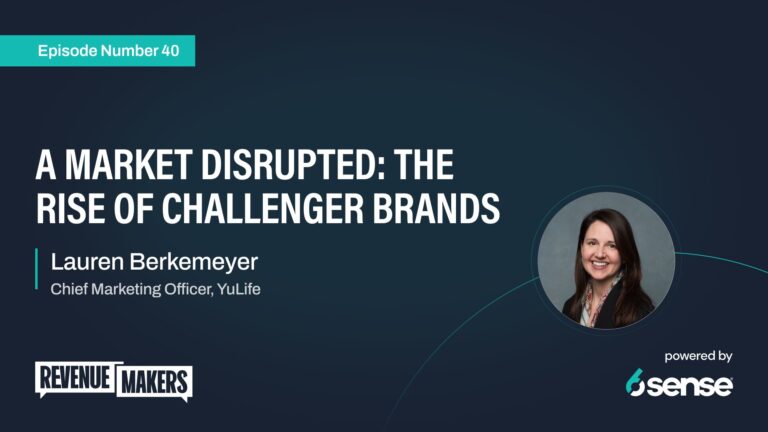
It’s a huge undertaking, especially in industries that don’t necessarily want to reinvent the wheel. Drawing on her own experience, Lauren Burkemeyer, CMO at YuLife, tells us what it’s like leading a challenger brand to success.
Lauren defines what a challenger brand is, and how these companies disrupt established industries with unique strategies. She emphasizes the importance of fostering a culture that embraces creativity and risk-taking, and how leveraging storytelling and social proof can build credibility for your brand.
Discover how to confidently position your brand against industry giants in this episode.
In this episode, you’ll learn:
- The definition of a challenger brand
- How to build trust with customers through social proof
- How to market your brand as an innovator in traditional industries
Jump into the conversation:
00:00 Introducing Lauren Berkemeyer
03:20 What is a challenger brand?
05:53 Building a culture of innovation and curiosity
07:35 Balancing demand gen and brand building
11:21 Establish credibility with social proof
16:09 Is a challenger brand the right fit for you?

The 6sense Team
6sense helps B2B organizations achieve predictable revenue growth by putting the power of AI, big data, and machine learning behind every member of the revenue team.