


You’ve gotta be pushing for the next big thing, the next better thing than what we accomplished. How do you do that? Well, They’d probably say I’m crazy. So we should give a little commercial break to everyone on my team. So I think you’d have to have a real authentic relationship with your team, and they have to know, and you have to prove that failure’s okay. This is revenue makers, the podcast by Sixth Sense, investigating successful revenue strategies that pushed companies ahead. Hey, Simon. We’re back again. Are you ready for another exciting episode? I am so excited. I’m number one excited to just be talking to Joe Wiltwang, who is the CMO of Corn Ferry, but I’m even more excited because the conversation is all about the fields. We’ve talked so much about the quantitative part of our jobs and performance and metrics and measurement and We’ll do a little bit of that with Jill, but I think the focus, which is very appropriate given that she is with Corn Ferry, which is the company that is all about getting the right people into the right roles, but how we really should be using how we feel and the qualitative part of running a team, being on a team to really drive performance. So I’m excited. Yeah. I definitely got the feels myself during the conversation. It was to sort of think about the people side radical humanity as she talked about it. So let’s dive in and really looking forward to hearing this conversation. Let’s do it. Alright, Simon. We are back again. Another episode, revenue makers. And we already had, like, a half of a episode that was so entertaining before we hit record. So we should just get right into it. Well, why didn’t you go ahead and introduce our guest, Adam? So Jill Wiltfong, CMO of Corn Ferry, who’s got, pretty amazing background, certainly in marketing, but, Jill, why don’t you talk about because your path is super interesting and exciting and fun. And I think just people wanna hear that story because I wanna hear again because I already heard it once, but I wanna hear it again. Alright. My path might be more exciting than my present. So we’ll we’ll link it in. No. No. No. Come on now. You’re Corne Fair. We talk about Corne Fair in a little while, but So I started out in TV news. I was a TV news anchor and reporter working at NBC stations and kinda bouncing my way around the country like you do when you’re in that profession. Finally made my way to New York. Little fun fact, I co anchored the news with my husband. That made for some interesting, I’m sure on air bloopers and moments. And then, you know, got to a point where I was like, you know, I’ve kinda know how to read out loud. So what am I gonna do for another thirty years? Just this? Like, is this this my life? So I went back to school, got an MBA and really wanted to get into the business world. So I started in consulting, and I was teaching and training people on presentation skills, and then it became selling skills, and then it became negotiation. And and one of my clients brought me in to help lead their sales department and it spiraled from there. You know, I think when people look at my background, they wonder, like, how does this all come together, but I see myself as a storyteller. And that’s what I’ve always done, and whether it’s in journalism, or then in business where I was either in sales or marketing or innovation and creativity, it’s always been about finding and telling great stories wherever I am. So here I am today, leading marketing at a really wonderful complicated professional services firm, and it’s different every day, which is one of the things I loved about TV news, And I love it. It’s been great. That’s awesome. And for those of you who are watching the video and are just listening to the audio, Jill Scott Emmy’s, behind her right now that we’re all looking at and, like, gloating over. So congrats to you. Thank you. My husband wanted to name one of our children Oscar ones and I’m like, you’re one. And that name is putting an Oscar. No offense if your name is Oscar, but it’s not gonna be an Oscar Wiltfong. That is a mouthful. But, yeah, it’s been a really fun journey. I love to reinvent myself. I love to reinvent firms. That’s part of the fun is is change in evolution. And hopefully, I’m living that as an example for my kids and people around me. I think that’s part of the journey. The heart of what we wanted to talk about today is really about measuring success. Guess, to some sounds easy to me, it sounds it could be easy. It can be hard because what’s your definition of success and understanding, like, are you gonna measure in the first place? Right? Because you can’t succeed unless you’re measuring something in the first place. So I guess just to jump in, what’s the rock solid essentials for measuring a revenue team. Like, what are some of the things, like, if there’s a framework, are there some k like, how do you start? And how do you think about that? So for me, I see two broad buckets, and it’s the facts, and it’s the feels. And I think they’re both really, really important. So you want numbers when you get facts. Right? You want numbers to show your impact that tells you kind of what’s going on right now. I also want numbers that are gonna shed light on adjustments and what we need to do next. And then I think you really need this feels element to it that, you know, if you’re looking at measuring the performance of a team, you don’t just want the facts. You want how they’re feeling. So you need to understand how engaged they are, how much pressure they’re under because those types of things are gonna help you to really understand. Are we underestimating where we’re gonna land? Are we overestimating and super optimistic with where we’re gonna land? Are they engaged in confident in loving what they’re doing because I feel like that’s gonna help us ride through the curve and accelerate through any curves or downturns that we might be in. So I always think about it as the facts and the fields, and and I do think it’s really important that you’ve got your finger on the pulse of both of those things. I love that. I love the feels part. Yeah. I’ve never heard anyone put it like that because the feels part of it is obviously going back to the confidence of the team in hitting the goals. It’s putting the numbers into context. I feel there’s so much that goes into making sure that everyone is feeling comfortable. Excited and really pumped up and to be able to hit those goals and those metrics. And that’s the shared path and north star, we wanna point our teams to words. And so talk to me about getting that part right. Getting the feels right, the goal setting right, making sure that there’s reality baked into it. Like, how do you even start to address some of those challenges? So for me, you gotta start with the growth strategy. What are the growth drivers for the firm to make sure that what your measuring matters, which is, I think, kind of, or at first point off the very top of the call. And sometimes that shifts a lot at some organization. Some kinda short term measure quarter by quarter. Others, I think, set a strategy for a few years and really settle into that thing. But I think it’s always a really good idea to check back with your line of business leads, with your revenue leads, with your sales teams to really just check back in on what are we working toward to make sure that what you’re measuring is still really relevant and driving and connected to that. And then when I think about feels and measuring. It’s not only of your own team, but we’ll actually even get into when we’re planning a campaign or planning a strategy. Not only using our head, but using our heart. So from a head perspective, you may look and say, this digital channel works. It delivers. Here’s our cost per leads. We know we wanna do that and put a a chunk of our dollars there on social and content syndication. And you kinda go through all of that and map out all of your goals. I always wanna make sure there’s a feel part. And we call them lightning strikes at Corn Ferry, but What are those things that are gonna get the people you’re serving, your sales teams, your rev teams, what’s gonna get them excited? Are they gonna be driving down the road and hear a commercial on XM Series and be like, that’s me. That’s my brand. Are they gonna get a phone call from a client who says, holy moly. I just saw you here, and that’s so cool. What are you guys up to? But I also wanna provide those things that you can’t necessarily measure quantitatively, but qualitatively, you know, are gonna energize your organization and energize your teams. So we try to balance a little bit of both and that quant, but also that qualitative field is I think super, super important and just keeping people motivated with a vision with the confidence that we’ve got this. Yeah. When you talk about the qual versus quant, when you get quant Mhmm. And I have a tendency to call people quant jocks, which maybe I shouldn’t do. But Yeah. There’s so much data now everywhere. Data is almost a commodity at this point. You can know everything about everywhere, anywhere, anytime. And trying to figure out what you’re gonna measure, trying to figure out what you keep an eye on. In your eyes, like, as you’re making that con versus call back and forth, When you’re looking at the data, how do you keep your eyes on the prize without just getting completely buried in every little data point. Yeah. It’s hard. You know, I’ve spent a lot of time marketing at research firms. So I love data, and I can get really energized by that. I think there’s a lot of metrics that are leading indicators of success that is a marketing team you need as a rev ops team you need to track. But it’s basic marketing. Right? You’ve gotta know your audience. So if you think about what you’re going to be reporting, think about them. And it may be two or three metrics you’re sharing with your finance team that’s different from the two or three you’re sharing with your line of business lead that might be a little different from the people that are interested in more of the PR. And maybe your investor relations team is much more interested in awards you’ve won, and, you know, very different things. So we kind of get our sea of metrics that as a marketing organization, we need to do our jobs. Think about a car. All the things that your car is like tracking in real time to make it run down the road, But then you get to your dashboard and there are, like, three things. You got your speed. You got your oil. You’ve got just a couple of things on there. And if you’re in a Tesla, you don’t have freaking anything in front of you. It’s doing all of the things for you. Yeah. Exactly. But I think it gets back to basic communications of know your audience know what matters to them. And then my plea is to drop all the marketing jargon and present those things using real words that they understand. And it can be a small thing. Like, we talk about MQLs all the time, but to the business, it’s leads. The SQL, MQ, like, all they don’t really care. It’s like, what are my leads? What’s my closed win rate? They speak in a language that you need to emulate so that these metrics are meaningful for them. And its segmentation. You’ve got your five hundred things you’re tracking. People can only remember three to five things. So with each group you’re communicating to, it’s plucking out those three to five things that are meaningful for them and telling that story. So they understand why they’re meaningful. And that’s it. It’s storytelling. I’m driving down the road sometimes. And one of my lights and my car goes on, you know, you’re talking about that analogy. You pull over because there’s so many lights now. Because when one of those five hundred things that is tracking goes wrong, they’ll look in the manual, and I feel like I don’t know. Maybe that’s just I’ve gotten older. And so, like, oh, my wife will send me a picture. I got this light. What does it mean? I’m like, I don’t know. So anyway, random side. But, are still moving. So I’m okay. Finding the red somewhere, but you don’t know what’s gone red just yet. So Yeah. No. It’s true. Which is why context is so important in everything, but in data in particular, and you hit on it a little bit, Jill, around serving up the right metrics to the right persona, whether it’s your board, whether it’s your PR team, whether it’s your investors, whether it’s your customers, even. How do you provide the right level of context around the metrics. It is storytelling, but it is also understanding this is what good looks like The number is five, but is five good or bad? Like, how do you really put everything into the context of how the business is moving forward? To me, you’re spot on, right, and having those kind of tangible best in class kind of metrics for people to understand what good looks like is critical. I don’t know if you guys have heard this. I’ve certainly work at an organization where there’s this sentiment of, like, you marketers, you’re, like, magicians. If you touch the numbers. They’re convinced we’ve manipulated the story. It’s so beautiful. This can’t be real. It’s so beautiful and perfect. So that context becomes really, really essential where we’re not just comparing ourselves against our best performance but we’re pulling in metrics from the outside. So this is what other professional services firms This is the average. This is how they’re doing. This is how we are versus them. The other thing that I think is really important is don’t always just tell the good news. Because I think that’s the fastest way for your credibility must be shot. And so be really consistent with what you’re showing and share some of the rawness, share some of the misses, because I think it helps you to be really real about what’s working and what’s not. But I think it also shows your organization you’re pushing. Right? If you are always slaying your goals and your targets, there’s no way you’re pushing hard enough or you’re full of it. Right? Like, that’s just true. Like, no one can be perfect every day. So I just try to be super consistent. Have those targets that are out there that show you what good looks like, and then don’t hide things. Really be clear on where we’ve missed and what we’re doing about it and talk about those things. I think that authenticity and realness is really critical. So you’re talking about, you know, you shouldn’t be slaying it every time. Obviously, the idea the goals. You’re gonna change them. They adjust up. Maybe they adjust down depending on what’s going on. But what would make you sort of change your context? Like, okay. We’ve been measuring these fifteen things, something has changed in the business or something has changed in the market dynamics. And it’s like, okay. It’s time to recontact realize where we’re looking or maybe we’re looking at different numbers. Like, how do you sort of, a, realize it’s time to make that change? And then, b, you obviously do it and then get it out there to sort of, like, okay. We have to sort of reteach or reorient the teams. I love this question. One, I think you gotta, again, stay connected to the business. And as the business shifts, you better be shifting. So I think that’s one litmus test. The other thing I think is we have to have, like, internal intrinsic motivation to be better. And I think that’s probably different for everyone, but let me give you an example of what we’ve done, and my team’s done at Corn Ferry, because I don’t know that everyone has done this. So We’re a team that’s been in place for five years. And we kind of sat down at the end of last fiscal year and said, gosh, five years. Like, that’s a long time. Let’s pretend we said that next year was year one of the next five years. Cause we’ve done great. Like, we’ve been monitoring things, things really good. Five years ago, marketing influence new business was seventy six million. Now it’s five hundred and fifty million. Like, we’re doing great. But can we do better? So we kind of self selected into, let’s revisit everything and just make sure we’re on our best game. What could we week, if we were brand new, what would we pull apart and critique and do a little differently just to keep us sharp? So I think there’s one thing about keeping your ear to the pulse of the business and as the business is shifting, whether again, intrinsically shifting because the business wants to shift or maybe there’s a market condition that’s forcing a shift. Those organizing events are really important moments to sit down and look at what you’re doing and revisit. But if not, my encouragement would be force an organizing event so that you can recheck, challenge yourselves, and implement some things so that you know your pushing as hard as you can. And sometimes you may push and fail, and that’s okay. You’re trying. But I think you wanna avoid the apathy, and you wanna make sure that somebody doesn’t come in and revisit everything you’ve done. You wanna be the one to do So stay on top of it and keep asking yourselves if we did this, then what? What if we tried this? What would happen? Just be nimble and attack. Love that. Modivating a team. Can we talk a little about that? I mean, of course, you’re setting the goals and those are the financial goals. But what you just said really struck me You’ve gotta be pushing for the next big thing, the next better thing than what we accomplished. You mentioned like a number where you had increased influenced pipeline by hundreds of millions, but that wasn’t enough. You’re still pushing the team to the next big thing. How do you do that? Well, they’d probably say I’m crazy. So we should give a little commercial break to everyone on my team. It’s like, can we just not change. Can we catch our breath here? So a little piece of it might just be my own manic meat for change, hence living in fifteen houses in my adulthood and that sort of thing. But I think one thing that’s really important is to be on the team. And I think a lot of times as leaders, and I can remember doing this when I was way before I was leading a team too, you, like, put on your leader pants. And this happens in, like, TV news. You’re, like, put on your TV news voice. And Like, you’re playing the role of a leader. I think the best thing you can do as a leader is be on the team. And, like, genuinely collaborate, get dirty. Sometimes you may be working for someone else on your team because they’re leading a project, and you’re not, you’re on the team. Other times you might be leading it, and people are reporting into you. But I think this shared accountability I think trust is super important for change and for pushing a team forward and working to create movements. There’s gotta be this trust that we can fail. And I think that probably gets in the way for most of us more often than not of changes scary because what if it doesn’t work? And change is really scary when things are working and you push to change and then what if that throws everything off? So I think you have to have a real authentic relationship with your team. And they have to know and you have to prove that failure is okay. If we learn from it and we move on and we have grit and we get back quick and keep moving. I love that being on the team getting dirty because I think having in my own experience, and maybe Simon can relate to this as well, Sometimes there’s certain execs or leaders who feel this necessary need to have some level of separation where it’s like, well, I’m here, and I’m delegating you, and I’m delegating there. And there’s this need for that. And I just love talking about being in the work, in the weeds, at some point, as you’re working with your team, and how do you navigate that sort of? You’re zooming in here. Obviously, your CMO, you’ve got a pretty significantly large team. You’ve got a lot of You got responsibilities to the board, your other executives, all that. What’s your method to the madness, or maybe it’s just sort of like, alright. Gonna go here. I’m gonna dig in deep. I’m gonna get versus, like, I’m gonna pull back. Let’s let the team do its thing. And maybe there isn’t any sort of real mythology to it. You sort of have the feels about that. But curious about how you think about that whole process and how you deal with the team. I think a lot of it, you kinda know who your team is. Right? And you know when people have it and you know when they don’t. And I think the more you develop trust within your teams, they’ll tell you when they don’t have it and when they need you. And I think that’s the really critical piece is having your finger on the pulse, and a lot of that is check ins. Yeah. Like checking in the people not just when you have a formal meeting plan, but trying to plan those informal catch ups, when I’m on my game and I haven’t been in the last few weeks for sure, but one of the things I’ll try to do is I don’t just randomly call people on teams to just literally check-in. I don’t want them to be planned. I don’t want them to be worried about it. I don’t want an agenda. I just wanna know how are you? We’re all remote. A hundred percent remote. So none of us have the ability to just kind of drop in and check-in unless we really force that. And I think in those moments is where I learn more than anything. Like, what’s going on? What’s happening with your mom? I’m so sorry. And all of a sudden, right, red lights are going off of like, oh my gosh. This is stress full. Surely, I can help out here. And I think when you offer help, you have to really be ready to get dirty and do it. So I think we have to avoid saying, like, I’m sorry. If there’s anything I can do, you let me know. I think as a leader, it’s our job to step in and just do. Just help. If you’re close with your team and you’re in the details, you’ll know when it’s time to kind of back off and back out. But I think you’ve gotta check-in. And my big thing, I have three children, and I’m pretty extroverted. My husband is, like, wacky extroverted and incredible we’ve raised three, probably because we’re so freaking loud, raised three introverts. And it’s completely changed my outlook about people and work. And just connections. And I will purposely seek out the quiet ones. To check-in, I will purposely try to recognize those people that I know don’t need it because it’s just not how they’re programmed. You got the person who’s always calling you. Right? And you know they need the love. I will purposely seek out those that don’t need it and don’t ask for it and don’t want it to make sure they’re okay. And oftentimes, I think it’s when things go quiet and dark that my spidey senses say, something’s not right. So I’ll listen for the anomalies, whether it’s sudden noise where it’s usually quiet or it’s sudden calm where there’s usually chaos, those anomalies to me kind of set me off of like, oh, let’s dive in. Let’s just do a quick check-in impulsively and just see how people are. And that’s kind of what I use as my guide. Is the unusual. Makes ton of sense. Love that. Yeah. It kind of harkens back to a post we saw on LinkedIn that you wrote about how to lead humans and not workers. And so much of what We, as marketers, as leaders, as just people in the workforce. It’s all about go, go, hit your goals, meet the expectations. How do you bound that with the need to, again, just have the human connection, and the check ins is a great way, of course, to force that, but what other tactics have you used? I really lean on my team a lot. And I think this idea of cascading communications, cascading leadership empowering the people around you, I think is really important. And I’m lucky to have a team of people that are very human, human first. We actually call it radically human at Corn Ferry. We don’t just wanna be human. We wanna be radically human and really authentic and real. And I do think it starts at the top. I think you, as a leader, need to set the pace for this. And then I think your next layer and that next layer can operate in the same way of being, but I think you have to show your own weaknesses and then others will realize I don’t wanna be the smartest person in the room ever. Like, if I’ve done that, I’m a really crappy person at hiring. I should never be the smartest person in the room. And so I I think if you just build this infrastructure of it’s okay to be wrong, it’s okay for me to be wrong. It’s okay for me as a leader to say, I know y’all want an answer right now. I can’t give it. I need a time out to think about all this, and I’ll be back. Or I don’t have the answer. What do you guys think? Let’s talk about this. This is complicated. Let me hear from all of you. I think that’s what creates kind of a human organization where I’ll be really honest about my teenager as to get his wisdom teeth out, so I’m not here, or my child’s having a tough day, or I gotta take my dog to the vet. Because not everyone’s a parent. Right? And I think the more you can just share of yourself, the more that comes back to you. And I think you get what you give. And if you expect an empathetic collaborative place where there aren’t heroes, we’re we’re all working together. If you authentically deliver that, I’d be shocked if you didn’t get that back in return. And if you’re not getting it in return, I would do some self reflection. Obviously, from this conversation, like, you’re taking an approach that is Very human, like you said. Radically human. And this is probably a rhetorical question. But how do you bring this ideology way of thinking, and it’s this radical humanity to somebody else to another leader who’s looking to, like, I wanna do better. How would you advise someone to do better in that sense? I think it starts by talking to your team, right, really understanding what they need, because I do think all teams are different in my style wouldn’t work everywhere. You’re leading a team, and critical is you’re leading a team. Right? You’re not the leader. You’re leading a team. So I think really digging into who is my team? How do they operate? How do they function? What feels good? What makes them uncomfortable is a really important place to start. And I don’t think one size can fit all. So I think if you’re not a slightly different leader, in every kind of interaction that you have, it’s also time to kinda think about that. Are you doing things that they make you feel good? Are you doing things because they’re good for the team and for this individual? Not everyone can take all of Jill a hundred percent of the time. So you gotta, you know, give them Now sprinkle it in. It might be a little much that I think it starts with really understanding what’s the climate of the team you have. And what are they starved for and where are they full? Yeah. Right? And understanding that dynamic, and there are lots of different assessments and ways you can go about that quantitatively and qualitatively. But I think that’s the best authentic place to start is with the team. And it’ll be pretty clear if they’re not super clear on where the gaps are right now. And then I think you plot a path forward, and you do need a good friend, and it is so lonely at the top. I feel for CEOs must be just lonely. So find your network, right, find those trusted individuals inside or outside your firm that you can confide in and and say, here’s my challenge today. Like, how would you handle this? You know, we all need coaches We spend so much money getting personal trainers for our health. But why aren’t we spending any money on getting a coach for our career. It is one of the most important things we can do whether you love your job or not. Right? You love your job and of course your career is like central. You don’t love your job, but you probably love what it earns you, which is it funds your hobbies, careers for all of us is such a critical component of our life. And why wouldn’t we get a coach who can help and guide and tweak and help us along on this journey, it feels kinda silly to me. And whether that’s a formal coach or informal coaches, you need them. So find that network, and you’d be amazed you know, I’ve got a couple of CMOs that we work in completely different industries, but for whatever reason we’ve connected, that I can call in a moment’s notice and say, Ugh. This is what’s happening right now. You know, talk me off the ledge, and that’s critical. I crumble without it. If you don’t have them in your firm, find them because it’s really important. Fully believe in the power of community. It’s funny that this conversation was about measurements and quantitative metrics. Yeah. And I love where it’s gone just so organically. And I think continuing on this theme of teams At six cents, we call our peers our first team. I mean, we talked a lot about managing down and managing the folks who report into, but your first team is really the folks who you all report into the same person. And so how do you make sure that you have alignment, for example, as a CMO with your CRO? And and with some of your other peers, like, I’m sure a lot of the same things apply, but is there anything different? If for me, I find this the hardest. And maybe because you don’t have that formal remit, you know, your own team, like, you’ve got a formal remit there that kind of forces this relationship and way of working. For me, the peer relationships are harder because there’s no formal structure around it. You have to go out of your way to do it. And for me, the most beneficial moments are the little moments. And I look at others that do this way better than I do. So our head of legal is incredible at if it’s been too long this happened earlier this week, he called me late at night and was like, hey, We haven’t talked in a while. Like, how are you? What’s up? Like, oh, tell me what’s going on. And that I think is what’s critical as not the formal relationships and the formal ways of working, and let’s meet every week and check-in and do reporting. And, like, all of that just happens I think where magic unfolds is in those other moments. If we all did that, Like, you could almost just have a list of everyone on your team, right, your peers. For me, it’s seventeen people. Right? So we got this long list And if I just kept that in front of me and was like, top of my list today is John. When I do my informal check-in with him, it’s like, check. Alright. The next on the list is Doug. And I just went through this list. And once a week said, just check-in with somebody and just work my and when I get to the bottom list, go back to the top, I think that would be transformational. I’m actually think I should try that because I haven’t tried that. But those informal moments, that’s often ethnicity. That’s real partnership. That’s I care about you. I don’t need something from you, and that’s what we’re all looking for. Somebody who genuinely cares. Yeah. Well, as Simon mentioned, it is kind of interesting where this whole conversation went. But, you know, we’re talking about measuring success and metrics and all, but we could just say success is the team. If we we started this whole conversation about it, ultimately, that’s where we went. The metrics happen. Right? The success happens if you get the way of working, right? Absolutely. The outcome of of great relationships and ways of working. So we have a traditional question that we ask all of our guests at the end, which is what is the most ridiculous thing you’ve ever had to do or been asked to do in your career? And it could be good, ridiculous. It could be bad, ridiculous. We’ve gotten some pretty interesting answers across from sun setting a product to a hundred customers in a day to All sorts of wild things. So anything that comes to mind for you that just stands out is, like, wow, that was nuts. One of the ones that I think was just a crazy moment that probably many in marketing can relate to. I was asked to lug fifty speakers to India in my suitcase. Like, cool, hot little speakers. And it was, like, just tuck them in your suitcase while you’ll that darn swag. Fifty. Exactly. Fifty. Right? So you can imagine it almost got me killed. Like, literally, my suitcase got confiscated in India. I had to get on this little rickshaw, which is already, like, anyone who’s been on a rickshaw in India knows trouble. Took me to the edge of the airport grounds in this warehouse that had this little building inside with no windows and one door. And it was like a whole bunch of people standing around saying if you want your speakers, you gotta go in there and talk to that guy. When I was just like, I’m not going in that room. There is no amount of money you can pay me to go inside that room. So I ended up pretending that I needed to go get money. I left, and and they were all like, you can’t leave. You’re on airport grounds. And I, like, flagged down that rickshaw and got the heck out of there, and I have not seen those fifty speakers in That’s probably my one moment of never carry fifty speakers. How do you even do that? They were small. They were like a little portable. No. Let’s just So Workable giveaways. Oh, god. Not a good PDF. That one’s enjoying those speakers probably till today. Yeah. Exactly. Exactly. Exactly. Somebody had a good night. Yeah. They’re probably throwing speakers around everybody. Right? Like, Oprah. You’re right. You’ll get a speaker. That’s right. That’s right. That’s my moment. Thank you. That was a good one that goes in the annals of revenue makers. So with that, I’m gonna say thanks so much. They’ll really, really enjoy the conversation. I learned a lot, and I got some feels, actually, from the conversation too. So I appreciate that. I’m so glad. I’m so glad. I’ve loved it. Thank you both. I look forward to hearing the next ones. This has been fun. If only every leader that we worked with or will work for applied some of those strategies. My gosh. What a better world it would be at, like, corporate side? So thank you. You’re welcome. It’s my pleasure. You’ve been listening to revenue makers. Do you have a revenue project you were asked to execute that had wild success? Share your story with us at six cents dot com slash revenue. We might just ask you to come on the show. And if you don’t wanna miss the next episode, be sure to follow along on your favorite podcast app.
Success is more than just crunching numbers.
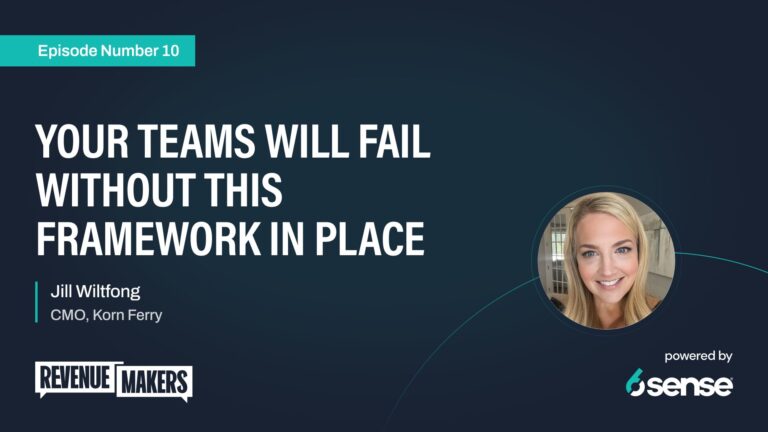
Jill Wiltfong, CMO of Korn Ferry, is defining what truly matters in driving your business forward. Discover how to avoid data paralysis by choosing metrics that resonate with all stakeholders and why storytelling in metrics is your unspoken edge in communication.
She’s sharing her tips to embrace a culture of transparency, context, and continuous reevaluation — essential tactics to inspire not just teams, but whole organizations. And, she’s got a framework to share that will change your business for the better.
Join hosts Saima Rashid and Adam Kaiser in an empowering dialogue with Jill Wiltfong that will leave you rethinking not just your business metrics, but the very essence of your leadership approach.
In this episode, you’ll learn:
- How to identify which metrics truly matter to your business. Jill stresses the importance of KPIs that align with your company’s goals and growth strategy. This approach helps prevent data overload and ensures that you’re not just busy measuring, but measuring what really counts.
- How to make your number story resonate with different stakeholders. Jill shares her expertise in presenting data through relatable stories that not only inform, but inspire action. By using this strategic communication approach, you’ll empower every team member to understand the significance behind the statistics and their role in achieving business success.
- How to adopt a flexible approach to performance measurement that evolves with your business environment. Jill discusses the importance of reassessing and adjusting metrics in response to market changes. Learn how to foster an environment of innovation and promote a culture of growing from both successes and setbacks.
Things to listen for:
00:00 From news anchor to business consultant and leader.
04:07 Data and emotions are both crucial for understanding.
09:12 Love data, use metrics, know your audience.
13:22 Contextual metrics drive consistency, authenticity, and growth.
16:48 Marketing influence grew from 76M to 550M.
18:57 Importance of being a collaborative leader.
24:06 Seek out introverts and recognize their needs.
26:03 Empower team, be radically human, authentic leadership.
30:22 Optimize actions for team well-being and cohesion.
32:09 Career support and coaching are crucial.
37:24 Suitcase confiscated in India; risky airport encounter.

The 6sense Team
6sense helps B2B organizations achieve predictable revenue growth by putting the power of AI, big data, and machine learning behind every member of the revenue team.