


If you have a growth mindset, you open yourself up to vulnerability, and you learn from your failures. I’m not saying that, you know, you intentionally failed to learn, but you are going to fail, as you said, Saima. And then, you know, what’s the best case from a failure, which is an education? This is Revenue Makers, the podcast by six cents investigating successful revenue strategies that pushed companies ahead. Hey, Adam. Yes. It’s our first two parter, believe it or not. And I hope it’s like the Godfather part too, where it would only be better than the first one. Of course. I mean, we have Guy Kawasaki. Let’s be honest. We spent longer than expected talking about assholes in part one. Yes. But there was so much more to cover. So we did, and we kept going because why would you cut him off? Because, again, he had so much great stuff to say. So this is part two. Everyone, thanks for coming back for part two, and enjoy it. Let’s do it. You think about leadership. You said leadership by example. You know, if you’ve got individual contributors that are that kind of behavior and then it becomes leaders, it becomes obviously much more impactful. What do you think are some practical ways? Like, I’m in a leadership position. I wanna lead by example. Right? I want it to obviously, performance is key. But how do I lead in a way that’s gonna inspire the teams to obviously hit what I want them to hit the goals, but also do it in a way that is not being an asshole. Well, I think you draw the line at successful people being irritating. Right? So, you know, if they’re irritating and maybe they don’t turn their expense reports in on time or maybe their desk is a mess or hey, man. Okay. There’s irritating and there’s assholeness. Right? And there’s a hard line between those two. So I would tolerate irritating. I would not go into the asshole level because I think it’s just toxic for the rest of the organization. And and as we said, you have to look at the total impact, not just the numbers, because one asshole’s numbers may affect the organization’s numbers in general, and that’s something to consider. Now as a leader of a team, I think that, you know, at some level, as you say, you lead by example. And a very good test would be, would you want your kids to be working for you? Let’s say you’re VP of sales. Would you want your kids to be watching you, like, I don’t know, going crazy on stage and ripping people and, you know, doing various abusive things. Imagine if everybody managed as if their kids were working for them or watching them, I think this world would be a better place. It’s a really good point. Yeah. So good. Alright. We’re gonna move off the topic of assholes. I think we’ve given them plenty of time. So, No pun intended, but we’ve drilled deep in Australia. There you go. I wanted to talk about innovation and, specifically, innovation through diversity. Right? Hiring practices, so many studies of organizational structure prove that more diverse companies just perform better. And it’s not just diversity, by the way, in obviously the makeup of the people, but diversity of thought and diversity of points of view. And so how do we expose our teams to various ideas and skills, especially on the marketing side where we want that principle to really drive innovation with the teams? Well, unfortunately, twenty twenty four in the United States, part of the answer to that question is what state do you reside in. Right? Because in some states, diversity is a no no. Right? I mean, I think it’s the stupidest thing. So first of all, I’ve read the studies about how diverse companies are more successful, etcetera, etcetera. And I understand that correlation is not the same as causation. But in this case, the data lines up with something I believe when, so that’s good. That’s nice and convenient. But I think the real test for diversity and inclusion and equality is not that, oh, you know, we’ve proven statistically that it’s two point five percent more profitable or something. I think it’s more like a higher calling, which is it’s just right. It’s just right. It’s not because it’s three percent higher. And quite frankly, if it was three percent lower, I would still be telling you the same thing. So, you know, maybe in this world, if you wanna do the right thing, you have to back it up with numbers. But then, you know, what happens when McKinsey in twenty twenty five comes out and says, we looked at Fortune five hundred companies with various levels of DEI, and the ones with higher levels of Doctor are not doing as well. So what? Now we all say, throw out the DEI so we can get better return for shareholders. I think that’s a really high risk thing, and I think you do it because it’s right. And just conceptually that I guess I believe that intelligence and ability is randomly distributed. So you can’t tell me that white males are more intelligent and better performers, etcetera. I mean, to the exclusion of LGBTQ plus and exclusion of other races and all that. I mean, I think it’s randomly distributed. So why would you preclude yourself from a talent pool just because of the color of their skin or just because of their sexual orientation? I mean, the managers of these companies, I mean, you have nothing better to do than worry about the sexual orientation of your employees. Like, you took care of marketing and sales and innovation and production and accounting and customer service. You took care of all of that. Now you can worry about the sexual identity of your employees. Give me a freaking break. So I just think that a diverse workforce brings you different perspectives. And diversity here means age. It means gender because I’m telling you women are better judgments on many things than men. I’ll agree to that. Frankly, you know, I would say that men have been blowing it for two thousand years. I think we just let women run the world for a while. Let’s see what we’ll give them the next two thousand years. So I think you cannot make a case that a homogeneous company is stronger. Another great implosion is the NRA. The NRA was pretty homogeneous. Right? I can’t tell you. I believe that that’s a shining example to emulate. And I’ll tell you another. This is a story that in the nineteen eighties, if you looked at Steve Jobs’ direct reports, half of them were women. And this is before me too, and this is before anti discrimination acts and all that. Steve Jobs, I believe he was color, race, sexual orientation, religion, you know, blind. He did not care. All he cared about was because he was a mission driven asshole. Can you help us make the best computer? And if you can, we don’t care about anything else. And, listen, there are a lot of scary aspects to working for Steve Jobs, but you weren’t scared of working for Steve Jobs because of the color of your skin, your religion, your gender, or your sexual orientation. Those things never were the factor. So much to unpack there, but there’s you know, people that are you know, you’re involved in a kind of discrimination. Maybe they have regrets later on in life. I I don’t know. But there was a different I’m gonna punt here a little bit. There’s a different section in the book talking about seizing opportunities. And again, like, that’s so much for personal success, company success. How do you lead or help prioritize the right opportunities so that sales and marketing leaders can make sure that they’re making the most impactful decisions without and this is like I’m like, guy, tell me how to have no regrets in my life. Obviously, you’re not gonna tell me that. But the most impactful decisions without regret. How do you enable that? I would make the case, although I don’t think you’re doing it, I would make the case that this is a trick question. Because if you ever had a guest that you asked that question and the person launched into this diatribe or this speech about how he or she knew exactly how to do that, I would say that you have a psychopath in your present. We just don’t know. And and as Steve Jobs said in his Stanford commencement address, you can only connect the dots looking backwards. Right? Now I address this concept of regrets in the book because Daniel Pink had a great project called the regrets project in which tens of thousands of people went online and surveyed and expressed what their regrets were. And guess what? The major regrets were not that they took too many risks. The major regret was they did not take the risk they should have taken. So that was regret number one. And I think regret number two was they let their social relationships deteriorate with their relatives and stuff. So, basically, I’m telling I’m not telling you I’m a guru with the answer, but I’m telling you based on what I learned from Daniel Pink, if you wanna minimize as opposed to eliminate, if you wanna minimize the regrets in your life, you take chances and you stay close to your family. That’s it. I love that. Those are words to live by. On that threat of seizing opportunity, taking chances, let’s be honest. Failure is inevitable. I mean, we’re all gonna face it in our work life, in our personal life, but I’m sure Steve Jobs, at some point, you know, had a series of failures before he hit that, as did some of the other leaders. In the book, you have the story of Halim Flowers and how you can really use your own setbacks or industry challenges as a catalyst for remarkable change and innovation. How do you think, you know, leaders, of course, sales and marketing leaders go to market leaders, but just in general, how can we do that? Well, if people are wondering, you know, what’s the story with Halim Flowers? Let’s quickly explain that. So Halim Flowers was arrested at the age of sixteen for being an accomplice to a murder. And according to him, he was not present when that murder occurred, but he was still convicted and I think sentenced to about forty four years. Amazingly, the person who actually squeezed the trigger, his case was dismissed. But Halim’s case as an accomplice went through, so he was sentenced to forty four years. And this was at age sixteen. And after twenty two years, he was released because the state of Maryland enacted a law, something to the effect that if you are arrested as a minor and you have served at least sixteen years, we’re gonna let you out. Because I guess the assumption is if you’re arrested as a minor, you really didn’t know what you’re doing and, you know, as a formative stage, whatever whatever. Anyway, he’s out. And now he has written books, and he’s become an artist. His art style, if you care to learn more about him, is of the ilk of Jean Michel. French words just befellow me. I’m not quite sure how you say Bastien. Bastien. Yeah. I think it’s Something like that. Okay. B a s q u I a t. Anyway, that’s the story of Halim Flowers. Now there are set backs. Some people’s set back is, I didn’t get into Harvard and Yale and Dartmouth. I had to go to, you know, UCLA or USC or something. Right? And I didn’t get that internship at Apple, or I didn’t get that internship at McKinsey, or I I never got hired by Goldman Sachs. That’s one level of setbacks, but not too many people served twenty two years in prison. And so that is a shining example of you can learn from your setbacks or you can let your setbacks destroy you. It’s that simple. I’ve never had a setback of that nature. Right? But, I mean, the flip side of every setback, the flip side of every failure is lessons in learning. When you make a Newton at Apple and you fail with that, yes, it’s a failure. You should not fail if you can, but you learn from Newton that maybe eventually happens to help you for an iPad. Right? Or you you make an Apple three and that fails, then it helps you make the next computer, like, not next as in Steve Jobs, but n e x t, the adjective. And I think that’s true that if you have a growth mindset, you open yourself up to vulnerability and you learn from your failures. I’m not saying that, you know, you intentionally failed to learn, but you are going to fail, as you said, Saima. And then, you know, what’s the best case from a failure, which is an education? Yeah. I was I put this in the back of my head as we’re talking, and I just I wanted to get back to it if we had some time. But we’re talking about mission driven and not assholes, but just mission driven as a whole. When you were I’m gonna keep no asshole. We we we I’m gonna keep it off too. When you look out in the world right now, whether it’s companies or leaders, are there, I guess, they say organizations that are are mission driven to a point where I mean, obviously, you’re involved with you work with Canva. They have great mission. Other companies or other leaders that you look at that you really admire and say, like, they are really bringing forth the idea of mission driven. They’re really encompassing that. Is there who do you look for and say, like, wow. That’s I look up to that or appreciate that. I just encountered something personally in the last few days that I tell you is the best example of mission driven ever. Okay. So I’m personal friends with Jane Goodall. And about a week ago, I went to her birthday party. This is her ninetieth birthday party. Now I want you to know so we go up to talk to her, my wife and I, and you can clearly see she’s just exhausted. And I can also tell you that I learned that she travels three hundred days a year. Three hundred days a year, ninety years old. Okay. Like, so all you salespeople out there, you’re complaining about I was complaining to Adam last week about my travel. So Yeah. Okay. And if you think about it, I travel as a speaker. Right? And when I travel as a speaker, the nature of my travel is I have to be on for one hour. One hour, I really have to deliver the goods. After that, I’m sitting in the hot tub. I’m working out. I’m, you know, eating pasta. But Jane Goodall, she’s, like, visiting all these schools, and she’s visiting all these nature centers, and she’s fundraising, and she’s meeting with major donors. And, you know, she’s working eighteen hours a day. Anyway, so I see her at this birthday party last week. I said, Jane, you’re just doing a great job. I think you’re wonderful. And then afterwards, I sent her an email. I said, listen, Jane. My wife and I, we have a guest house. So anytime you wanna get away from the fundraising and the education and the travel and all that, You come to our house. You stay at our house. We’re not gonna ask you for autographs. We’re not gonna ask you for selfies. We’re not gonna, like, ask you for anything. You just chill out. Okay? She sends me an email, and she says, you know, guy, there is no time to do that. I have to do what I have to do. Look at that. I says, ninety year old woman traveling three hundred days a year. I offer Well, god, no. Now I Well, god, no. Now I’m just gonna stop complaining in general. And I’m gonna tell my kids that story, by the way. When they have to unload the dishwasher and they have to make their bed, it’s like, well, Jane Goodall is not taking a day off. You better watch out because kids have a way. They’re gonna, like someday, you’re gonna tell them, oh, I’m tired. I don’t wanna go to your game. They’ll say, Jane Goodall would’ve gone through. I guess, you better watch out how you use that example. There you go. So, Guy, on the flip side, I guess, who’s the worst leader you’ve had to ever had to work for or you’ve ever had to encounter with? I mean, we’ve got this example of what great looks like. Honestly, I have not had any boss that I would, like, really bitterly complain about because Let’s Let’s take an extreme example. So let’s say that you had a really promising career. You had a great academic record, and you thought you had it made in the shade because you went to work for Theranos. Okay? Theranos, the company that raised four hundred million dollars and got the most blue ribbon board of directors and blah blah blah blah. And then now the COO or COO are both in prison, and guess what? They’re faking their results and all that. Or I see this is, like, horrible for your track record and all that, but I would make the case that you probably learned the most valuable lessons of your career working for Elizabeth Holmes about trying to be something you’re not, about faking it until you make it. Holy shit. I was I mean, you cannot find a a worse example than that. And so I hope anybody who worked for Theranos I don’t wish bad on you. Well, actually, I interviewed the whistleblower in that case for my podcast, so I know inside stories. But that does not have to plague you. If you go through your life saying, god, we almost pulled it off. If we just coulda gone one more quarter, we had that result coming. Or if you learn, you cannot lie. It’s just morally wrong. That’s the lesson you should learn, not that shit. If we only had gotten away with it, we were so close. I think that’s the kind of lessons you have to take, and I think that’s the way. So you can learn a lot from a really bad leader. You really, really can. That’s the irony. What can I say? It’s almost like that could be another another book. Just lessons from really bad leaders and just start to go through and just look unremarkable unremarkable people could be just as educational. Right. Yeah. That’s good. We have a question that we like to ask all of our guests, which is, what is the most ridiculous thing that you were either asked to do or had to do in your career? And it doesn’t necessarily have to be ridiculous negative. It could be ridiculous ultimately positive. We’ve gotten answers from smuggling giveaways to India to sunsetting products in twenty four hours that affected hundreds of customers. Curious, like, what is ridiculous for you that you’ve encountered? Yowza. So the most ridiculous thing I had to do okay. This this may seem like a funny thing and a small thing. It’s certainly not like smuggling anything or anything. But before I was in tech, I was working for a jewelry manufacturer, and we were fine jewelry manufacturer. I was in sales and marketing. So from time to time, I would go out on the road, and I would go sell pieces. And one of the rules of our insurance was that these pieces, expensive pieces, they were either in a safe in a hotel or they were with you. I mean, you’re holding them. So you couldn’t just check your bags in with the valet or, you know, you couldn’t just leave it in your room and go out to dinner. You either had it in your hand or it was in the safe. So once I was showing this very expensive diamond necklace to it was to the owner of the Turnberry Isle Racquet Club or hotel or whatever, and it was for his wife. And the woman wanted to see what the necklace looked like on her, which is reasonable. Yeah. You know, you buy several hundred thousand dollar necklace. You’re gonna see what it looks like. And so she wanted to go into the ladies’ room to look in the mirror. And by the terms of the insurance, I interpreted that I could not let this woman wear the necklace and go in a ladies’ room. So I had to go into the ladies’ room with this moment. She could see the diamond necklace. And, you know, let’s just say that this is a really hoity toity country club. Right? And, you know, the the only agents there were the waiters. So, I mean, now we have this waiter walking in woman’s bathroom with this that was kinda ridiculous, but I did it. But you did it. That’s pretty ridiculous. For sure. That that was a learning experience also. That showed grit. It showed grit and grace, I’m sure. Alrighty. Guy Kawasaki, you Alrighty. Guy Kawasaki, you are remarkable. I’ve enjoyed this so much. Thank you for the time. Thank you for the insights, the swearing, the honesty, all of it. Yeah. I really I’m not a profane person. I get it. But I’m a writer, though, and I could tell you that there is just no better way to say if you said do good stuff or do good things or be innovative or bring revolution, it just doesn’t have the impact of do good shit. What can I say? Hundred percent. Hundred percent. I’ll be banned in Texas and Florida, but that’s okay because I swore and I supported DEI. Besides that, you know No. Thank you. I’m a cool guy. Yeah. We love you. Alright. Bye bye. Bye. You’ve been listening to Revenue Makers. Do you have a revenue project you were asked to execute that had wild success? Share your story with us at six cents dot com slash revenue, and we might just ask you to come on the show. And if you don’t wanna miss the next episode, be sure to follow along on your favorite podcast app. App.
Maximizing revenue growth is not just about the numbers—they’re about the story behind them.
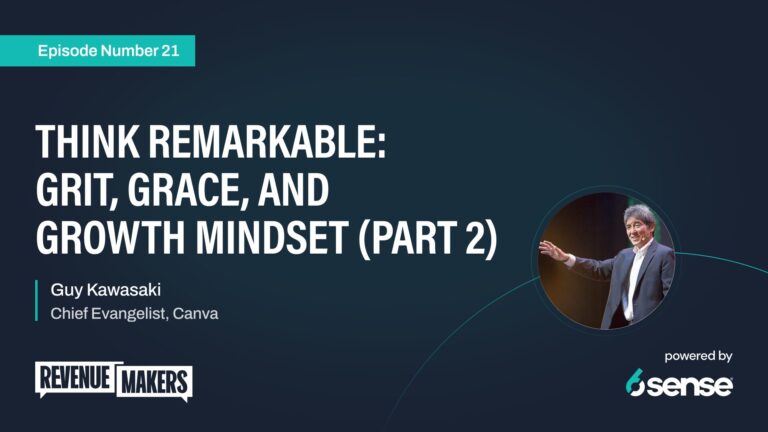
In this riveting second half of our conversation with the legendary Guy Kawasaki, we certainly heard some stories. Guy spoke about seeing failure as an opportunity for learning and how to cultivate a company’s soul starting with mission-driven business approaches. Never one to shy away from blunt truths, Guy laid out how embracing diversity—not just demographically but in thoughts and experiences—can propel companies to profound success.
Guy is all about leading by example and ensuring every action aligns with a deeper purpose, beyond mere profit. Listen in for a chance to reflect on your leadership, the diversity of your teams, and how you handle failure—with one of the absolute best players in the game.
In this episode, you’ll learn:
- How leading by example and fostering a culture of respect and inclusivity impacts team performance and revenue growth.
- Why diversity and inclusion aren’t just checkboxes but essential components of successful companies.
- The undeniable value of experiencing failures and learning from them. Setbacks and failures are merely stepping stones on the path to achieving greater success.
Things to listen for:
05:12 Intelligence and ability are randomly distributed everywhere.
14:03 Jane Goodall exemplifies what it means to be mission-driven.
17:08 Learn from bad bosses, like Elizabeth Holmes.

The 6sense Team
6sense helps B2B organizations achieve predictable revenue growth by putting the power of AI, big data, and machine learning behind every member of the revenue team.