


I would say that if companies are wondering about, okay, is sales development the right move for us and the right investment for us, I’d probably ask the first question of, like, do we have clarity to begin with? I’ve been at companies where I walk in, and I’m like, what’s our ICP? And they’re like, well, we can sell to anybody. I’m like, okay. So we have no idea where we win, and now we’re gonna put the entire responsibility of figuring that out on the sales development team. So it’s like, alright. We also have to make sure, like, responsibilities are appropriately allocated to within that when we’re thinking about clarity and, like, what is our overall go to market motion gonna look like? This is Revenue Makers, the podcast by six cents investigating successful revenue strategies that pushed companies ahead. Alright. So, Saima, outbound is dead. The SDR role is dead. LinkedIn’s upper case caps lock posts. Yeah. I think people need to get their keyboards fixed. But, anyway so we’re here to prove otherwise because we have a great guest today, Gabriel Blackwell. She’s been in sales development, business development, leadership for quite a while. She’s become quite a thought leader in the space as well, puts out a lot of great content. And we talked to her about the state of the role, the state of outbound, and it is very much alive. You mean it’s not dead? It’s not not dead. Or if it was dead, I think we resurrected. No. It’s not dead. It’s evolving just like there was everything else in the world. It was a good conversation. Leadership, career path, of course, we’re gonna talk about AI. But at the end of the day, you know, what this reinforced is I mean, at Sixense, we love BDRs. I am holding up a little sticker right now. I love BDRs. And we place a real importance on the business development function in the organization. And, you know, we talk about what makes those teams successful and how you too can take some of these tips and tricks and nuggets and really build a world class well oiled machine. Yeah. And some really just straight talk, which was always nice to hear. So let’s do it. Let’s do it. Alright. Gabrielle, thanks so much for joining us. Looking forward to chatting. So I am just gonna go. Let’s do it. Let’s go hard. So sales development is dead. Outbound is dead. It’s all dead. Right? No. Yes? That’s what you see when you go on LinkedIn, and it’s a whole lot of people amplifying each other’s Death’s nail. Everything’s dead. Yeah. I was thinking about this earlier today in preparation for a conversation. I’m like, what could I say to this? And my response to the statement of, like, sales development outbounding is dead. To me, it screams, tell me, you know, nothing about modern day pipeline generation without telling me, you know, nothing about modern day pipeline generation, especially if you are selling, like, what I call, like, high technology, high ticket sales items, going after enterprise mid market accounts, you can’t rely solely on inbound. And then what I’m seeing as well with organizations today is they have to do a lot more with a lot less, and that has a tangible impact on frontline, especially AEs. And so, sure, there are the folks who are the hyperachievers, AKA are highly insecure without their, like, awards and accolades. And so they’re gonna do a hundred and fifty, two hundred percent as an AE. However, that’s not gonna be the majority of your team, and they’re gonna need support. And by majority of the team, I mean probably eighty percent of AEs. And so you can quote me on that one. That’s the hill that I will climb up. I’m not gonna die on it because nothing’s dying. I’m gonna live on it. And the teams for the companies that are cool with that, then, like, we’ll be successful. And everybody else have fun having a life. Well, I think that’s again, we could say that about every job. Right? There’s gonna be your top performers, and they’re gonna be motivated and inspired to exceed then crush all their goals. But let’s be honest, We gotta build for the majority of us, and we gotta learn to run those teams, manage those teams, arm those teams with the right skill set, the right tools so that they can also be successful. Yeah. And as you were saying that, Saimo, something I was thinking about is because like you said that outbound is dead, and immediately they’re usually the ones commenting on each other and boosting their posts, and they’re all within the same communities and the same incubation tools and the same brand shares, whatever you wanna call it. And there’s one thing that I do see about them is they were the top one percent of sales reps when they first started. And so that’s, like, a lesson that I had to learn. So when I was a sales development representative, I was a top rep by a measure of two, three x the next person. And if I’m always trying to build an operation for me, I’m going to fail sixty percent of the time, probably. So, yeah, the importance of actually building for the average sales rep, I think, is incredibly important. Yeah. And just to make it very clear, we put a whole lot of importance on our SDR motion, our BDR motion. We run BDR appreciation week every year. They are the lifeblood of our revenue team, and we set really high goals for them. I mean, in the marketing organization, well over forty percent of our pipeline question oiled machine. It’s a huge game changer for us. Can I ask a question back to this? Because there’s something you mentioned about having a well oiled machine. And if I’m being really honest, I do believe in the phenomenon of being set up to fail, like the set up to fail syndrome. I’ve I’ve always seen it happen within, okay, like an employee and a manager relationship. I also truly believe this can happen on a departmental level. And so the sales development organizations or the sales organizations go to market organizations that I see work really well that have an SDR BDR crew in it, like, they have a well oiled machine. And a lot of the folks who I see talking about sales development is dead or even inside of companies, they’re like, how do we prove out the ROI of sales development? They don’t have a well oiled machine. And so I’d love to hear from y’all when you think of well oiled machine within your go to market operation and how sales development and business development fits in that. How do you think about setting up a well and business development fits in that, how do you think about setting up a well oiled machine? Yeah. It’s a great question. I would say it starts with clarity. Clarity around goals, of course, but clarity around expectations of the role. Are we asking you to do a little bit of everything, or do we have a really clear motion and workflow that you’re expected to follow that is repeatable and can scale? Right? So we do a lot of work around just aligning our BDRs to specific AEs, separating out what they’re doing, whether it’s inbound, whether it’s outbound, whether it’s to drive adoption or upsell. Right? So that number one, I think that clarity is probably the biggest piece. And then there’s enablement, training, coaching, and that is tied to metrics. We have weekly scorecards that go down to the team and rep level where we can see who’s doing really well and who’s not doing so well and what activities, characteristics of their role is helping them either achieve or underachieve. And that’s not, by the way, to name and shame. That is to understand what it takes to have a really successful rep and use that data to coach the ones that might need more coaching or might need a little bit of more time. And so I think the clarity, setting the expectations, and then having the metrics really guide the coaching and arming our reps with the right tools and the right process. It’s a pretty simple formula. I don’t think there’s anything earth shattering in there, but I think if you do it consistently, it really helps. And you also you know, looking at content and your overall go to market, I think a lot of times BDRs can feel like they’re off in the corner of just go book some meetings. But really bringing together you’re pointing the ship someplace. Everyone’s gotta point in the same direction. So we’re talking about Yeah. You have a a number, but what does that number mean? What’s quality? What are the type of meetings that align to that message, that align to what we’re selling? I could see the BDR role being in some organizations pretty isolating to a sense. I mean, it’s a t, but you can feel like you’re kinda in the corner. And you don’t really know what’s going on in the business, and you’re just being expected to drive a pipeline, pipeline, pipeline, but there’s no story behind it. We at sixth sense, I think we do a pretty good job of that. I know some other organizations that do really great job with that as well. And then I’ve been in places where I’ve had BDRs come to me, and they’re like, what is this? I don’t know. And it’s enablement messaging, so it’s so important. Yeah. I was writing down notes as you both were sharing. It’s just very refreshing to hear this, especially because, again, the conversation of sales development instead, to me, is a reflection of probably a lot of conversations that are happening at certain companies, like, even internally where they’re like, oh, things aren’t working and sales development can easily become a scapegoat. And some of the things that you were mentioning, both of you have, like, clarity, especially. And then what is the goal? What is the message? What is the quality? Right? So just really having clarity around what is good, what is success for us, and what does that mean for each department, SDRs included, and, like, how does that support everything else? I would say say that if companies are wondering about, okay, is sales development the right move for us and the right investment for us? I probably ask the first question of, like, do we have clarity to begin with? Do we know what we’re selling? Do we know who we’re selling to? I’ve been at companies where I walk in and I’m like, what’s our ICP? And they’re like, well, we can sell to anybody. I’m like, okay. So we have no idea where we win. And now we’re gonna put the entire responsibility of figuring that out on the sales development team, but we’re also gonna metric them and hold them to performance expectations of an organization that has already figured that out. So it’s like, all right, we also have to make sure, like, responsibilities are appropriately allocated to within that when we’re thinking about clarity. Phenomenal SDR leader. And I will say some of the secret to our success is just having a really great frontline team. Can you talk a little bit about what makes a great manager? Yeah. I love that topic. Thank you. Thank you. So I think what makes a really good manager, first and foremost, is expertise in sales development. Unfortunately, there are a lot of folks who are heading up and granted, this is not the manager position, but it does impact managers. You cannot just have somebody who’s never I shouldn’t say it’s never done sales development role. But, like, if you are bringing somebody in who has never been immersed into the sales development function before in their life or the business development function, and even more so, I’ll say, into a modern demonstration of sales development, AKA just because you read predictable revenue. No shade to Aaron Ross on that one. But I was like, that is a very outdated model. It’s super outdated, super expensive. It’s not efficient. It’s not effective. And unless your company’s name is Salesforce, it’s not gonna work for you probably. And so I think, you know, just having somebody who, like, really understands the modern day or innovative approach to sales development and business development, and not just from a theoretical level, but really from an operational lens. How do we see this lofty idea? And how do we actually put this into practice? So that to me is just, like, kinda just operational rigor that’s there, and disciplinary expertise is what I’m gonna call it. Then I think you also have to marry in the fact of, like, okay, it’s one thing to come up with orders, but I’m gonna be honest, in this year, twenty twenty four, you can’t just treat people like dogs and expect for them to do their best work. Maybe in the past, when my grandfather was a salesperson, that worked because there weren’t maybe as many options or there was, like, so much opportunity at that one company. But I really do believe, like, you have to know how to treat people like people, and you have to spend the time to actually build relationships with folks. And there’s a skill set of, like, self awareness that’s super important. But we need to have leaders, and I don’t mean people who are just cracking whips. I call them dashboard jockeys, and they know what to say to stay out of trouble, but they don’t know what to say to earn discretionary effort from their people. I love that. Wait. Say that again. Earn discretionary effort from your people. Yeah. So I can’t remember which book it was, but it was talking about there was, like, a formula’s performance as it relates to salespeople. And it was, like, the first variable plus a couple other variables. But the first variable I remember, which is a relationship. The relationship between a manager and their employee has such a significant impact on performance that if you act like it doesn’t matter, sure, you might get accessible performance for a short period of time. But let’s say you’re having an off quarter. Let’s say that one of your fully ramped reps leaves the team and you’re still holding on to their number, and they haven’t contributed to it. Then say, Adam’s one of my top performers on my team, and I’m gonna go, hey, Adam. I know that you do really great work. Is there any way I can get a couple more opportunities for you? Same thing for you, Saima. And if y’all are like, you only come to me when you want something from me and you offer nothing else, there comes an expiration date to using fear as a motivator. I’ll say that. Like, people are only gonna do that for so long before they’re gonna say, you know what? I’m tired. I’m burnt. It’s taking too much effort for me. I think that’s where he starts having those shooting stars kind of performers, the ones who do really, really well, but then something happens, they taper off. It’s like, where’s the relationship? Where’s the development? Where’s the care? And especially for sales development, especially knowing that it’s very common where sales development reps, business development reps feel like they’re on an island. For that to be reinforced to them from their manager, it’s going to have a deleterious impact on their performance. And so we got the operational rigor. I think you need to have the human care to things. I think also with the operational rigor, actually understanding the numbers and understanding the metrics. And it’s not being a data scientist. It’s about being a critical thinker. So there are gonna be a lot of times where folks look at the dashboard and they’re just like, okay, well, so and so is not hitting their number. They just need to make more calls. It’s a lazy train of logic. Let’s dig in more. Let’s see what else might be going on here. Let’s not just look at the first level data. We gotta go, like, two or three more layers deeper. And even then, we need to bring it up with the rep and see what’s going on here and come up with a coherent narrative as to what’s happening and then how to resolve from there. And so even with that, there’s interpersonal skills and knowing how to do about the feedback. There is a level of critical thinking that’s required as well. And I think there also has to be a certain level of humility and being okay with not knowing the answers and collaborating with reps to actually come up with a solution. So it’s not dead as we’ve just established. And, obviously, you just talked about leadership being so incredibly important. I think that’s just a great deep dive into that, but it’s not dead. We know it’s not dead, but it’s changing and it needs to change and continue to evolve, right? And there’s so many outlying factors, you know, and we get to I don’t know how many times AI comes up, but certainly that’s a factor into it. Just the way people buy is different, the economy, so many different things. I mean, we see it every day, but from your perspective, what has changed in recent memory and what do you think needs to change and where do you think things are going? I have a triple loading question, so I’m just piling it on. Sorry. What has to and needs to and will change, I guess, is probably the way to say it. Tell us everything. Yeah. So I had the really lovely opportunity to speak at y’all’s user conference, Breakthrough last year. And I can’t remember exactly what it was called, but it was like modern day outbound, something along those lines and kinda how you should be doing things. And to me, the change is there has to be, again, more of an importance on strategic and critical thinking within the organization. So the predictable revenue sales model, it runs like an assembly line for a car manufacturer. Right? Like, a lot of the stuff was, like, lean principles. So if anyone’s ever worked, like, project management or software development, like, you’re gonna see that. Like, the only thing is that pipeline is not developed in the same way that software is. And there’s different inputs. There’s different outputs. And we’re talking about working with people here. And so if we keep on having this model of just volume equals sales, I’m just gonna give this one story real quickly, a little bit of context. My grandfather worked in sales at IBM from the late sixties to the late eighties. He was very, very successful, worked his way up into leadership. So he’s somebody that I’ll call and be like, hey, Papi. I’m running into this thing. And how do I go about this? And I’ve told him all these things, like, here’s the technology that we’re using. Here’s the numbers that we’re looking at. And he’ll just go, wow, Gav. Things have changed. He’s like, back in my day, back in my grandfather’s age. He’s like, you know what we did, what our formula was? Was? Calls plus demos equal sales. Those are the only variables that we can look at. And I’m like, okay. Well, now we’re flooded with data. What are the variables that we actually should be looking at? I think, Simon, you had mentioned this, like, what are the metrics? Right? And then also, we need clarity, like, how do we know that we’re moving in the right direction? So I think there has to be strategic mindset from a leadership perspective, and then how that trickles down in terms of the kinds of reps that we wanna bring on board. Not everybody’s gonna be successful at sales development. And if we’re just hiring people as if it’s an easy job, we’re gonna set people up to fail. We’re gonna set managers up to fail. We’re gonna set up a department to fail as well. And so for me, when I’m thinking about the people that I wanna bring in, again, like, I’m like, I want strategic and critical thinkers big time. I wanna get the folks on my team who are the future entrepreneurs. Very honestly, like, they wanna actually go and seek out problems that they can solve, and they can put a value to it as well. I want people who are really great storytellers too. So they’re able to go, you know what? If I just make this brass tacks, it’s not gonna work. But if I really take the time to understand what is a human behavior, what is a human motivation here, like, what are the actual tangible impacts, the things that we can measure, And how do we string that together in a very compelling way that gets people bought in? How do we evangelize a message of what is a problem we’re solving for this person? We also need to have people who are empathetic. So we’d have somebody who’s just coming in as like, yeah, I’m just trying to get a paycheck, and I don’t really care. Those are not the right people for the teams, managers, senior leaders included. And so that to me is the thing that has to shift is, like, more of an importance on critical thinking, more importance on strategic thinking that influences everything from what is the data that leaders are looking at to make decisions for investments? What is the kind of technology that we’re going to invest into or divest from? It’s going to come into like, how are we going to manage change and what changes should we actually be making to like, how are we going to measure the effectiveness of this? And so a lot of times this is what I’ve seen anecdotally. I’ve worked in a lot of companies these past, like, nine years that I’ve been working in software sales is don’t have a strategy. And therefore, they’re just like, we’re just gonna throw spaghetti at the wall and hope it sticks. And then it doesn’t. And they’re like, I don’t know how to prove out the ROI. I’m like, yeah, because you actually never defined it. So to me that the shift really is, as I mentioned, those two things like critical strategic thinking, and it’s embedded everywhere. Leaders making decisions, enablement in terms of, like, how they’re thinking about enabling folks and what they actually need to be enabled on to I think with the use of, let’s say, AI or technology, it’s more about how do we help reps make better decisions faster. It’s not just, oh, hey. Like, how do you whip out a email automatically that’s personalized? To me, it’s more about, alright. We know that these accounts over here have x percent higher chance of converting within this time frame. However, reps, it takes them plus two weeks to actually find those accounts. How can we help them find those accounts two weeks faster knowing that’s gonna have a higher propensity to convert? And so that to me is where the application of AI technology really would be super potent and powerful. So let’s dig into the AI conversation since you went there. You know, another all caps lock thing that, like, somebody will put in LinkedIn is the SDR role is dead because of AI’s taking our jobs. Right? And to us, we actively leverage AI assistance in our go to market motion. But while it’s generating a higher proportion of pipeline for us, it’s actually also making our BDR metrics improve. The output of the BDR team is higher. I look at metrics all day, by the way. So the pipeline for BDR is up for us. So it really is a force accelerator and a force multiplier in what I’ve seen. But what are your thoughts around the role of AI specific to the sales development role? For me, I feel like there are certain things where I just appreciate being a simpleton as much as possible in certain conversations. And for me, the context here is so I started off as a sales development rep going outbound after, like, fortune five hundred companies, had like the best territory. Thank you, manager. Appreciate you for that one. And, the year was twenty fifteen. Sales engagement platforms did not exist. I remember downloading a Chrome extension called Mail Tracker. And so when you send out an email, you would see the two check marks like you would see on a WhatsApp message. And if somebody had read it, that’s how you would know. So I’d have to go through my like Outbox and see, like, who opened up the email and then try and give them a call and prioritize that way. That’s an example. And then we got this is when HubSpot sales or HubSpot had a sales engagement platform that was more like yesware. So you couldn’t actually, like, tailor anything. You couldn’t, like, rep you just had to have your campaign set up and hopefully you put somebody in the right thing. But I got all the tracking metrics from that. I don’t know if we would call that AI, but that to me is an augmentation to my process or an assistance through technology that now I don’t need to, like, go and manually check what’s going on. I already have a list and I can build that out. So some of that took me an hour now only takes me thirty seconds to do. And so I think for the application of, let’s say, AI within this, I’d say companies are already doing this. If you have any kind of scoring algorithm for top accounts, let’s say, based off of whatever inputs you wanna have. So whether it’s Sixense insights, whether it’s they’re looking at certain pages, whether it’s using, let’s say, LinkedIn sales insights as well, to score accounts and bubble those up or even dashboards. Like, we’ve been using technology to assist. And guess what? It hasn’t taken out people’s jobs. It might eliminate the folks who are not keeping up with the times, the people who aren’t adopting the technology, the folks who, like, if they had an option, they could work thirty hours instead of sixty and get a hundred percent instead of sixty percent. I think there’s just been too many applications of technology that have helped drive efficiencies and effectiveness that, like, the conversation around AI, it should be one done with more curiosity than fear. Now anybody who’s below average, I think that’s where, personally, it’s more like an individual thing. You have to ask yourself, like, okay, how can you use technology to make sure you still have a job? And then I think for maybe certain solutions or services that are really low ticket, that’s much more transactional. Again, for me, it’s like, if I’m a sales rep there, I wanna start seeing how can I become masterful leveraging technology and being a really great operator to solidify my spot, whether it’s at this company or another company? But I don’t think the role altogether goes out. So I would say almost like a refreshing sort of look at it too. Right? Because of so much of the And we’ve had other AI topics and we’ve talked about it’s not coming for your job, it’s changing your job, it’s making you more efficient. And it’s good for your career to know AI and basically that, you know, if you remember, and I think I said this in another episode, it used to be like on the job description, be like, you have to know how to use Word and Excel, PowerPoint. And it’s just gonna be know how to use generative AI, whatever solution that particular company might be, or just in general. So I think that’s a really good perspective on it. But given we’re talking about people, we’re talking about a role, I think it’s natural to talk about career progression with SDRs because that’s something where everyone talks about it’s the bench. They’re potentially going to be moving into sales roles. And we have so many BDRs and sixth sense that have become sellers that have done incredibly well. But in my own personal experience and other roles, there’s some changes there. And I think even we’re seeing a little bit at sixth sense as well, that BDRs are evolving, but they’re evolving into different places other than just, oh, I’m gonna go carry a bag and be a rep. Anything that you’re seeing on your end there? Because there’s some interesting things I think that are happening there. Yeah. I’ve seen a lot. So, again, context for me is when I got into sales, like, starting with a sales development position, like, I didn’t really know what an account executive was. I didn’t know if I wanted to be account executive. I was just like, listen, y’all. Let’s be real about this. I needed a job, and I just wanted to make sure I was doing something that I felt like I could be good at and stay interested in. And sales was it. I never thought about starting in sales to stay in sales, very honestly. So like, that’s just the perspective that I have. That being said though, so the first time I started managing was in twenty seventeen. Since twenty seventeen, I’ve probably managed directly managed seventy people. Out of those seventy people, I can put on one hand the number of people who came in knowing they wanted to be an account executive. That’s the first thing. I think the second thing that’s happened as well, like especially post COVID, think about how the demographics have shifted as well. So the hiring profile back in, like, twenty fifteen, what I can remember, like, the boss that I had, the way he thought about it was you’re hiring people who are straight out of college, Right? Or you’re hiring for folks who have maybe, like, one year of experience. And they did really well, but it wasn’t their calling. And so they get into sales and there we go. Well, now we have these folks who had entire careers before stepping into sales. So think about all the teachers who left the academic world. Do you think about all the academia who left that space, who got into sales, all the folks who’s working in hospitality and service industries? And also, I think, too, what’s happened like, post George Floyd is there’s been a lot more of an emphasis on increasing representation of typically underrepresented demographics and as well as post me too. You’re having more women. So, like, everything has changed in a, like, industry that’s been typically male oriented, and on top of that, typically white man oriented too. And so once upon a time, sales was pretty homogeneous, and it makes a lot of sense why people would all maybe be more inclined to follow the same path, but we’re just not dealing with that anymore. And so I think that’s the first thing. That’s one of the reasons why things have changed. I think, secondly, some of the things that have happened too is, let’s be honest, selling is way harder these days. I see and I hear the old heads who are like, sales is always hard. I’m like, listen, y’all are not selling during a global pandemic. And there’s so many things happening in the world right now. And there’s also so much access to information to what’s going on. It’s not the same. And so what I see happen is folks who are in the SDRC are already like, this is exhausting. I’m so tired. I talked to my AEs. They have no lives. And so they’re, like, super stressed out and, like, people aren’t buying and they don’t have any kind of work life balance or the one rep that’s doing really well. They’re like, I don’t wanna work like them, but they look at customer success and they look at renewals, and they go, you know what? I’m carrying some kind of bag. I’m still customer interfacing. I’m still, like, heavily involved in a platform and a topic matter that I like. And there is a perception of a much better work life balance. I’d much rather go over there. And so that’s really what I’m seeing happening is most folks, a lot of reps, again, if I mentioned like like five out of seventy wanted to be AEs, I have much more folks who have been promoted into the CS organization of renewals or like the post sales organization or even sales and solutions engineering, then I have seen people be promoted into an AEC. And I just think the skill set that you get from sales regardless is gonna help you no matter where you end up. The communication skills, the influencing, all really great great skills. Yeah. The hustle. There you go. Yeah. One of the things I’ll share with my folks is, like, even if sales is not the thing that you wanna do long term, that’s okay. One thing that you can get here is you can learn what it takes to develop a really great work product and deliver a really great work product. And we have the benefit of it’s tangible. You can measure it. So, like, if you’re gonna go on interview for another role and you need to have a story of how you did, in sales, it’s really easy to tell that story. But we have to deliver a really great work product for you to be able to move to where you wanna move to. So we could probably go on for very long time on so many different topics. But just to round things out a little bit, and this is gonna be a little bit of a curve ball for you, but we have a question that we ask all of our guests, which is what is the most ridiculous thing you’ve ever been asked to do in your career? And it doesn’t necessarily have to be a negative thing. It could be something very positive. And we’ve gotten answers from smuggling to sunsetting products for a hundred customers in twenty four hours to all sorts of different things. It could be wild or it doesn’t have to be wild. So what do you got? I bet you got something good. You definitely have something good. I know you do. I’ve got one, and it’s funny because it’s it was involved with our marketing team too. It was terrible. So I was running at this company many, many moons ago, and marketing team it’s one of these fun things. It was like the market team was like, we’ve generated so many leads, so many leads, and we’re not getting any pipeline. Sales development team was new, and so it was easy to be like, well, sales development team doesn’t know how to convert these leads. And I was just like, what are these leads that you’re talking about? And I was like, how about this? You give me a report of all the leads that you say that you’ve generated that we haven’t converted. So it was laughable person sales development team and then a twenty person AE team. So they’re like, wait. Like, a six person sales development team and then a twenty person a e team. So, like, we did a hundred and fourteen. Right? I said, yes. No one, like, specifically asked me to do this, but I needed to do it to, like, basically prove that I was not fully and completely incompetent at my job. I had to go through one by one, and it was a hundred and fourteen, and say what happened. And what we claimed to find out was there was a system error where it would duplicate or triplicate, quadruplicate the same weed over and over and over again. And so it completely, what do you call that? Inflated our numbers big time. So e wait. So even the hundred and fourteen the standard they were qualified. It was just fourteen valid leads or names, I should say. Fourteen valid profiles. Wow. So I think my boss actually did ask me to do this. He’s like, hey. Can you please whatever. And I’m like, y’all pay me way too much money to do this, but okay. I actually remember the VP of sales is my boss’s boss. I was in the meeting room, and I’m going through this, and he could tell I was so frustrated. And he’s like, what’s going on? I’m like, when do I get to stop being a data dummy and actually do my job? He’s like, what do you mean? And I was like, there’s only fourteen valid names in phone numbers and emails and profiles. I don’t even know that these are worthwhile leads to go after. And we’re trying to say that the SDR team doesn’t know what they’re doing. That’s pretty ridiculous. Wow. Fourteen. So that’s for alright. So all fourteen converted into millions of dollars, likewise. So you’re fine. No. No, no, no, no, no. I was like, yeah, if you got like zero point seven leads per SDR and AE for the quarter. Yep. Fantastic. SDRs are the pro sales development is dead. Yeah. Absolutely. Absolutely. Well, Gabrielle, thank you for this great conversation. Great insights. Really appreciate you joining. And I guess any last parting thoughts from you before we jump off? No. Go high five a sales development rep. Ask them like, hey, what’s up? What’s good? What’s, like, one thing that you wish could be a little bit better in the role? Be surprised probably to hear, like, little tiny fixes. And I have this on my desk. I love BDRs. Yeah. I love BDR. You love them. Thank you so much for joining us. Appreciate it. Thank you. You’ve been listening to Revenue Makers. Do you have a revenue project you were asked to execute that had wild success? Share your story with us at six cents dot com slash revenue. We might just ask you to come on the show. And if you don’t wanna miss the next episode, be sure to follow along on your favorite podcast app.
Approached with the right strategy, expanding enterprise contracts can lead to big wins.
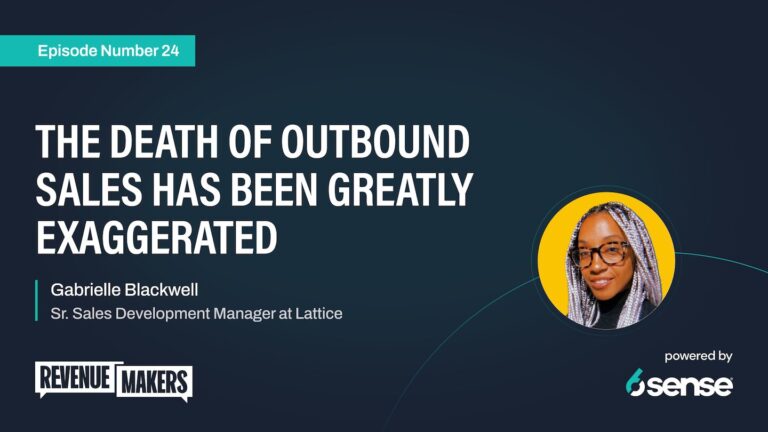
In this episode, Gabrielle “GB” Blackwell, senior manager for sales development at Lattice, talks about the evolving landscape of outbound and sales development, debunking the myths that these strategies are obsolete, and shedding light on their critical role in modern pipeline generation.
Gabrielle shares her thoughts on the importance of clarifying strategy before investing in sales development, and her emphasis on supporting the entire sales team, not just top performers. And Gabrielle’s insights on relationship-building, strategic thinking, and the human element in sales leadership are bound to resonate with today’s sales development professionals.
In this episode, you’ll learn:
- How to have clarity in sales development before investing in sales management and aligning business development representatives (BDRs) to specific account executives.
- The importance of a cohesive and efficient sales development team and supporting the majority of the sales team, not just focusing on top performers.
- The role of AI and technology with AI as a force multiplier and accelerator in sales development, AI improving BDR metrics and pipeline generation and how technology has streamlined sales engagement processes.
Things to listen for:
04:13 Rethink your strategy to include the average sales rep.
08:42 Clarity of feedback and well-stated goals are essential for successful sales development.
12:21 Make no mistake: the relationship between manager and employee affects performance.
21:40 AI and technology can streamline your process, but they’re no replacement for honest work.
26:32 Sales challenges during the pandemic proved that a new approach is required.

The 6sense Team
6sense helps B2B organizations achieve predictable revenue growth by putting the power of AI, big data, and machine learning behind every member of the revenue team.