
Folklore Debt: When past success becomes a constraint.
In B2B, every company has its founding mythology, its hero stories about first, biggest and best sales, quarters, and years, how it scaled, how it fought off competitors, and many other narratives besides.
These narratives form a company folklore that shapes culture and decision-making. But, these narratives often long outlive their useful lives, to the point that they lock us into ways of working that no longer make sense. When this happens, our treasured stories become folklore debt (like technical debt, but with stories).
Curious where your organization stands?
As you read through the research below, you may start recognizing these patterns in your own go-to-market. We built a free tool to help you identify and name the narratives that may be shaping how your organization operates today.
Part I: The Origins of Folklore Debt
The Stories That Build B2B Companies — and the Ones That Hold Them Back
Joseph Campbell’s The Hero with a Thousand Faces is often remembered as making a claim about human storytelling — that cultures across time and geography tell strikingly similar hero myths. But Campbell’s deeper point wasn’t really about the stories. It was about the life histories of individuals and cultures, and about how they form their identities.
Human lives, for all our surface variation, tend to follow a broadly similar arc. People are born dependent, mature, face uncertainty and challenge, learn independence, discover interdependence through relationships, perhaps raise others, and — if all goes well — eventually confront aging, decline, and death.
Different cultures don’t tell similar hero stories by coincidence; they do so because the people who make up those cultures are grappling with the same fundamental life-history challenges.
Franklin Roosevelt may not seem to have much in common with a recently deceased Yanomami tribal elder, but it can at least be said that, in the immortal words of Morrissey, “they were born, and then they lived, and then they died” (The Smiths, Cemetery Gates). What’s more, in this example, they both faced challenges associated being a leader.
And we can be sure that those are just a few among many other milestones they and virtually all human beings share across their life journeys.
The stories we tell persist because they help people make sense of the milestones, transitions, and even eras through which we live. They normalize risk, encode lessons, and give meaning to struggle.
Joseph Campbell taught us how the stories we have told ourselves are similar to the ones people from different times and places have told themselves – the timelessness of those stories.
And he spoke about how the stories must evolve to meet the modern world. As an example, Campbell cited the first Star Wars movie as a reasonably faithful retelling of the legend of King Arthur, while also echoing stories from Greek mythology, the Hebrew bible, and Siddhartha (The Buddha).
The B2B Hero with a Thousand Faces
B2B companies, it turns out, follow a surprisingly similar pattern.
Organizations are born small and fragile. They struggle to survive. They find early sources of traction (or not). They learn how to stand on their own (or not). They scale, form alliances, compete, and eventually face the challenges of maturity: complexity, slowing growth, internal coordination, and adaptation. If they’re successful enough, they confront their own versions of aging and decline.
And just as human societies produce, maintain, and evolve myths to form their identities and explain life stages, companies produce organizational folklore to form and explain theirs.
In the broader world, the folklore a society or group develops is shaped by the environment in which it exists – the ecology, resources, as well as the groups and cultures with which the society interacts. That is why the narratives that help equatorial tribal people in Papua New Guinea navigate their lives have much more in common with the narratives found among equatorial tribes on the Amazon – on the other side of the globe – than they do with farming or urban communities with which they share the island of New Guinea.
Likewise, the narratives, the folklore, that companies develop to make sense of their own histories, and to motivate future behavior, owe much to the environments in which those companies exist.
That’s how folklore debt begins: not with false stories, but with constrained imagination.
The Role of Organizational Folklore in the Life of a Company
Every company develops stories about how it got started, how it broke through, how it won its first meaningful customers, and how it survived moments when failure felt close at hand. These stories circulate through sales kickoffs, onboarding decks, leadership talks, and hallway conversations. They identify heroes, explain victories, and quietly define what “good” looks like and how “we” solve problems and relate to one another. The shape the company’s identity.
Often, they are codified in rules of engagement among employees and the company’s stakeholders.
These stories have thousands of faces, but just a few core themes:
- The scrappy team out-executing incumbents
- The visionary insight that created a new market from nothing
- The breakthrough deal that accelerated hyper scaling
- The guerrilla marketing campaign that went viral
- The process, tool, or vendor that “changed the game”
These stories perform essential work in a company’s formative years. They create coherence out of chaos. They enable fast decisions when data is scarce. They give people confidence to act under uncertainty.
But just as myths can outlive the conditions that produced them, organizational folklore can persist long after the stories have become obsolete, living on into stages of life in which the old stories are not only no longer a fit, but may prove harmful.
Just as companies can accumulate technical debt as they grow, they can also accumulate something quieter and harder to diagnose.
They acquire what we call folklore debt.
The Railroads: We Are a Railroad Company
In 1960, Harvard Business School professor Theodore Levitt published what became one of the most cited articles in the history of management thinking — “Marketing Myopia.” His central example was the American railroad industry, and it remains as instructive today as it was then.
The railroads, Levitt argued, were not in trouble because of cars, trucks, or airlines. They were in trouble because of a story. They had defined themselves as railroad companies rather than transportation companies. The distinction sounds semantic. It wasn’t.
A railroad company builds tracks, operates trains, and competes with other railroads. A transportation company moves people and goods from one place to another by whatever means makes sense. One story constrains the solution set. The other expands it.
The railroads’ folklore – what shaped how railroad executives thought about who they were and how their companies were defined — celebrated engineering mastery, infrastructure scale, and the romance of the rails themselves. That story had been accurate and powerful — the railroad barons had transformed the American economy. But when automotive and air transport arrived, the story about themselves that they were committed to couldn’t accommodate a world in which the rails were one option among several. The identity was too specific, too tied to the mechanism rather than the mission.
Despite having the relationships, the logistics expertise and the capital required to dominate new transportation modes, what followed was a long, grinding obsolescence — not because the railroads lacked resources or intelligence, but because the identify shaped by the dominant narrative could not accommodate new opportunities.
Levitt’s insight was that this was not a railroad problem. It was a story problem. And story problems, he warned, recur across every industry where past success hardens into self-definition.
What Technical Debt Teaches Us About Organizational Folklore
Technical debt is a familiar concept in software and technology organizations. It describes what happens when teams make expedient decisions — shortcuts, workarounds, early architectural choices — that are entirely rational at the time. Those decisions allow companies to move quickly, ship product, and survive their early constraints.
The critical thing to understand is this: technical debt is not a mistake; it’s a tradeoff.
Over time, however, those early decisions accrue interest. Systems become brittle. Change slows. Innovation requires increasingly complex workarounds. What once enabled speed becomes a constraint.
Folklore debt works in much the same way.
Strategies and Principles for Effectively Managing Organizational Folklore Debt
Folklore debt accrues when the stories a company tells about past success stop being contextual explanations and start functioning as general laws – which may or may not be useful.
In early stages, folklore creation is not only natural — it’s necessary. Young companies lack data, process maturity, and time. Stories fill the gaps. They simplify reality just enough to allow action. In that sense, folklore is a cognitive accelerant.
But as companies grow, the environment changes:
- Markets mature and fragment
- Buyers become more experienced
- Competition intensifies
- Scale introduces complexity and obsolesces once-effective business practices
If folklore is not revisited and evolved, it can collect in a company’s arteries, stifling the circulation of new ideas and practices.
The organization continues to behave as if:
- That kind of deal is still the model
- That buyer behavior is still effective
- That process is still appropriate
- That tool or vendor is still uniquely enabling
- That effort will still produce the required result
At that point, folklore stops being cultural glue and starts becoming corporate quicksand.
Kodak: The Company That Invented Its Own Disruption — and Looked Away
Kodak’s folklore debt is perhaps the most documented in American business history — and the most painful, because the company missed the very future it initiated.
In 1975, a Kodak engineer named Steve Sasson developed the first digital camera. The technology worked. The company understood what it meant. And then the story took over.
Kodak’s self-narrative was inseparable from film. Not photography — film. The chemistry, the processing, the paper, the retail relationships, the recurring revenue model that film represented. That story had made Kodak one of the most valuable companies in the world, and it ran so deep that it shaped not just decisions, but what counted as a real business opportunity in the first place.
Digital photography wasn’t rejected by Kodak. It was managed. Licensed, developed incrementally, kept from cannibalizing the core — a textbook case of what Clayton Christensen would later call the innovator’s dilemma. But underneath the strategy was something simpler: a story about what Kodak was that couldn’t accommodate what digital photography would become.
By the time the story was revised — by the market, not by Kodak — it was too late. The company filed for bankruptcy in 2012. The engineer who built the first digital camera watched it happen from retirement.
The lesson isn’t that Kodak was blind. It’s that organizations see what their stories allow them to see.
Why Folklore Feels Like Wisdom
Folklore debt is difficult to detect because it doesn’t feel like mythology. It feels like truth. Sometimes the stories accurately reflect what caused the early success. Often, they just seem to. Either way, they nearly always gradually become obsolete.
Success stories are emotionally salient, socially reinforced, and retrospectively shorn of untidy counter-narratives. Over time, they become simpler, more coherent, and more certain than reality ever was. Ambiguity disappears. Context fades. Causality is inferred where correlation once lived.
This creates fertile ground for self-deception.
Richard Feynman famously warned, “You must not fool yourself — and you are the easiest person to fool.” In organizations, folklore makes that self-fooling easier by shaping what evidence gets noticed, how it’s interpreted, and which explanations feel intuitively correct.
When data aligns with the story, it feels like validation.
But how often is the new head of sales, employee number 1,152, going to have the moxie to tell a founder that the story they tell about why they hit unicorn status is only a partial truth and, that aside, is not the appropriate model for the next stage of life?
Nokia: The Narrative That Found Its Rightful Home
The standard Nokia story goes like this: dominant mobile phone company, missed the smartphone revolution, lost the business. It’s a clean cautionary tale, and it isn’t wrong.
But it misses the more interesting part.
Nokia’s organizational folklore was built around hardware engineering excellence, technical depth, manufacturing precision, and the credibility that comes from building infrastructure-grade systems. That narrative made Nokia the dominant mobile phone manufacturer in the world through the 1990s and into the 2000s. It was genuine, deeply embedded, and hard-won.
When Apple introduced the iPhone in 2007, it fundamentally changed what a mobile phone was. The category shifted. The product was no longer primarily a hardware engineering product. It was a software, ecosystem, and user experience product. Nokia’s corporate folklore had never had to take software and user experience seriously, and it was not able to adapt. The story that had made Nokia great in one era became a liability in the next.
Nokia sold its mobile phone business to Microsoft in 2013. What happened next is the part that usually gets skipped.
The company refocused on network infrastructure — the equipment and systems that mobile networks run on. And something interesting happened: the old narrative fit. Hardware engineering excellence, technical depth, manufacturing precision, infrastructure-grade reliability — these are exactly what network operators need from a supplier. Nokia’s folklore, which had become a constraint in consumer devices, turned out to be a genuine competitive advantage in a different segment of the same industry.
Nokia today is one of the world’s leading network infrastructure companies, competing effectively against Ericsson and Huawei in the 5G buildout.
Instead of replacing their narrative, they replaced the category in which the company fit to match their narrative. IN so doing, they forfeited their earned share of a massive and continually growing category. Fortunately for Nokia, they quickly found a category that did fit their narrative.
The lesson is important: folklore debt can be an extraordinarily powerful contributor – or blocker.
Folklore, Analytics, and the Illusion of Insight
This is precisely where folklore debt becomes most dangerous: when it begins to shape, not just decisions, but how evidence itself is interpreted.
Dashboards and metrics are curated to align with existing beliefs, rather than current realities. Tools and tactics are judged successful — or exempted from blame — because they were present during periods of growth, not because their incremental impact has been isolated and tested.
None of this is malicious. It’s narrative gravity.
Once folklore establishes what “worked,” confirmation bias erases aspects of the current story that don’t reinforce the folklore, perpetuating — or at least not countering — the myth.
- When the company has a soft quarter, the founders call out that today’s sellers are not cold call prospecting CEOs as they once had.
- New programs are put in place to reinstitute the behaviors that lead to early company success.
- When this approach fails to yield expected results, this is interpreted as a failure of the people in current roles rather than a change in the state of the market and the company.
- People are fired. New ones are selected for their experience that parallels what the founders believe worked in the past.
- When this fails, these new people leave or are fired and the cycle is repeated.
In this way, folklore debt quietly undermines the very thing analytics is meant to provide: learning.
IBM: The Mainframe and the Near-Death Experience
For most of its history, IBM’s organizational identity was inseparable from a single story: we build the machines that serious enterprises run on. The mainframe wasn’t just a product; it was the mythology made manifest. IBM’s culture, its sales motion, its hiring profile, its compensation structure, its relationship with customers — all of it was organized around that story.
When the PC revolution arrived, IBM participated in it — and then promptly missed what it meant. The company’s folklore told it that the real money, the real business, the real IBM, was still in the mainframe. The decisions that followed — including the fateful choice to outsource the operating system to a small Seattle company called Microsoft — were shaped at least in part by a narrative that made it difficult to see the PC as a serious threat to the center of gravity.
By the early 1990s, IBM was losing billions of dollars annually and many observers believed it would not survive. What followed, under Lou Gerstner, was one of the most studied organizational turnarounds in business history. Central to it was something that looked less like a strategic pivot and more like a narrative revision: Gerstner famously refused to articulate a “vision” in the early days, because he understood that the existing vision — the existing story — was precisely the problem. Before IBM could build a new mythology, it had to stop being governed by the old one.
Sacred Cows: Processes, Vendors, and Metrics
Folklore debt shows up most clearly in what organizations stop questioning.
- Processes become untouchable because “they’ve been proven to be successful.”
- Vendors become entrenched because they were part of an earlier success narrative.
- Metrics persist because they once pointed to how success happens.
Over time, these elements become sacred within the organization — not because they are optimal, but because they are protected by narratives that are so deeply rooted in the organization that they go unquestioned.
This creates a subtle but powerful form of inertia. New evidence struggles to gain traction. Alternative approaches feel risky — not because they are unproven, but because they conflict with company identity as portrayed in the folklore.
The organization confuses “why we won” with “why we will win in the future.”
It’s important to note that folklore doesn’t just live in stories. It gets hard-coded into systems.
Legacy beliefs show up in the structure of go-to-market strategies, CRM configurations, the construction of onboarding decks, the layout of sales demos, and even in how pricing tiers are presented on a website.
These product, process, and delivery patterns are not neutral — they’re narratives made manifest.
The old saw has it that, to a boy with a hammer, every problem looks like a nail. In organizations with folklore debt, the hammer is the story — and every challenge gets reframed to fit the myth that once worked.
And to borrow yet another cliché, when narratives outlive their relevance, company folklore can eat strategy for breakfast.
Ford: Any Color, As Long As It’s Black
Henry Ford didn’t just build a car. He built a story about how manufacturing worked, what customers wanted, and what efficiency meant. The Model T and the moving assembly line weren’t just operational innovations — they were the founding mythology of industrial capitalism, and Ford was its prophet.
For a time, the narrative was entirely accurate. Standardization was the insight. Volume drove affordability. The customer didn’t know what they wanted until Ford showed them.
But the story calcified. By the mid-1920s, General Motors — with Alfred Sloan’s segmented lineup of models at different price points — was eating Ford’s market share by doing the thing Ford’s mythology said was unnecessary: giving customers choices. Ford’s response, shaped by the founding narrative, was to double down on standardization and efficiency rather than adapt.
The Model T, introduced in 1908, was discontinued in 1927 — not because it stopped being a good car, but because the conditions that made its underlying story true had changed completely. Ford survived. But it never fully recovered its early dominance, in part because the founding folklore had become too sacred to revise.
Folklore: Three Sources
Folklore debt doesn’t only grow from within. It also arrives from outside — and understanding both mechanisms matters for managing it effectively.
One
Organic Folklore
Stories from a company’s own early wins harden into rules that outlive their context.
Two
Imported Folklore
Stories brought in by leaders from prior companies are applied without proving they fit.
Three
Ambient Folklore
Stories from the broader market define what success should look like—before it’s tested locally
Organic Folklore
Organic folklore forms the way we’ve described: a company survives early chaos, wins meaningful customers, finds traction. Stories form to explain what happened. Over time those stories simplify, shed their context, and harden into operating principles. The organization mistakes what worked in one era for timeless instruction.
Imported Folklore
But there is a second, equally powerful mechanism: imported folklore.
Folklore is portable. Leaders carry narratives from prior companies — about what GTM should look like, how great sellers behave, which metrics matter, what kind of motion scales. When a new sales or marketing leader is hired, they often arrive precisely because of the success narrative they’ve earned elsewhere. That narrative is part of what made them attractive.
The problem is that imported narratives carry no inherent warranty of fit. A story that accurately explained success at one company, in one market, at one moment in time, does not automatically transfer. Yet it often arrives with the full credibility of hard-won experience — which makes it more persuasive, and harder to question, than stories the organization generated itself.
When the fit is poor, the damage can be swift. A new leader’s playbook reshapes hiring profiles, reorients measurement systems, and redirects budget — often before the organization has had time to test whether the underlying narrative applies. One person’s hard-won success story can quickly become a whole company’s folklore debt.
HP: When the Culture Arrived Before the Leader Did
Hewlett-Packard’s founding story is, in many ways, the original Silicon Valley folklore. Two Stanford engineers, a $538 investment, a Palo Alto garage, and an ethic of engineering excellence, employee respect, and decentralized decision-making that became known as the HP Way.
For decades, the HP Way was genuine competitive advantage. It attracted exceptional engineers, retained institutional knowledge, and created a culture of trust that enabled collaboration across a sprawling, complex organization.
By the late 1990s, however, HP was at a strategic crossroad, and the board believed the company needed transformation, not continuity. They hired Carly Fiorina — explicitly for her narrative: a bold, transformational leader who had driven dramatic change at Lucent.
The problem was that Fiorina’s playbook had been built in a different organizational context, with a different product mix, a different competitive environment, and a different culture. She arrived carrying imported folklore — about how transformation works, what bold leadership looks like, and how legacy cultures should be disrupted — that had been earned elsewhere and did not transfer cleanly.
The collision between imported narrative and entrenched organic folklore was both public and damaging. HP’s board ultimately dismissed Fiorina in 2005. The episode became its own piece of industry folklore — a cautionary tale about the gap between a leader’s story and the organization that story is meant to serve.
Ambient Folklore
There is a third channel worth naming: ambient industry folklore — the shared narratives that circulate through investor networks, accelerators, trade media, and peer communities. A founder in Boise and a founder in Bangalore may never meet, but if they’re reading the same blogs and chasing the same investors, they’re likely internalizing the same stories about what success looks like and how it should be built.
- Big Series A raises
- The quarter that achieved unicorn status
- Founder = grand visionary
- Growth validates truth
This ambient layer shapes organizational folklore before a company has generated much of its own.
Regardless of founder background, the ambient narratives of regions such as Silicon Valley, Wall Street, Tel Aviv, or within segments such as SaaS, telecom, or marketing agencies often supply a relatively small menu of narratives that influences how folklore develops within organizations. For example, for decades the predominant folklore of Silicon Valley included themes such as, “my parents’ garage” and “two guys and a dog.”
These stories don’t just circulate. They create expectations — from boards, from peers, from investors — about what success looks like, how it should sound, and what kind of narratives earns trust and confidence.
Over time, this pressure limits the range of narratives they believe are valid in the first place.
A slower growth story, a modest product thesis, or a cashflow-first strategy often isn’t rejected — it’s never seriously considered, because it doesn’t exist within the canon of narratives that circulate within the community from which the founders arise.
And the restricted set of narratives constrain how companies develop and grow.
Organic formation, importation, ambient absorption — these are the three channels through which folklore enters an organization. All three are natural. All three can become debt. And as we’ll see in the next section, all three respond to the same discipline: narrative hygiene.
Apple: Silicon Valley’s Founding Folklore
The story of two Steves building the first Apple computer in a Palo Alto garage is one of the most potent pieces of corporate folklore ever told. It is also, as origin stories go, largely true — which is precisely what makes it so sticky.
The garage story did essential work in Apple’s early years. It encoded a set of values — scrappiness, iconoclasm, the individual genius defying the establishment. There was a taste of Henry Ford’s ego – knowing what the customer should want – in the origin story. And a charismatic found who gave the company a coherent identity when it had almost nothing else. It attracted a particular kind of employee and a particular kind of customer.
But the garage story also carries folklore debt. The “visionary founder who defies convention and is always right” narrative — an elaboration of the original myth — contributed directly to the conditions that led to Jobs’ ouster in 1985. The board and senior leadership had internalized a version of the story in which the founder’s intuition was the company’s primary strategic asset, making it nearly impossible to manage him as the organization grew in complexity.
When Jobs returned in 1997, he did something unusual: he revised the mythology rather than simply reinstating it. The “Think Different” campaign honored the original spirit while explicitly repositioning Apple as a challenger — relevant not because of what it had been, but because of what it stood for now. It was, in effect, an act of deliberate narrative hygiene at company scale.
Managing Folklore Debt Without Killing Culture: Five Key Principles
The answer is not to eliminate stories. Organizations without folklore are brittle and transactional. The goal is to become narratively self-aware – to understand when narratives need to be retired, transformed, or augmented.
- Treat stories as hypotheses, not truths.
- Separate outcomes from mechanisms.
- Encourage counter-stories.
- Revisit folklore as context changes.
- Use analytics to challenge comfort, not confirm it.
We’ll explore these principles in greater depth in Part IV, where narrative hygiene is operationalized step-by-step.
From Myth to Learning System
Folklore is inevitable. It is human. It is often powerful.
But stories that once helped companies move fast can, over time, prevent them from moving in the right direction. Folklore debt accumulates quietly, disguised as wisdom and experience.
The most resilient B2B organizations are not the ones without stories. They are the ones that know which stories they are telling — and why.
- They honor their myths without mistaking them for laws.
- They use data not to protect identity, but to update it.
- They let folklore inspire action, not replace thinking.
That balance is hard. But in complex, fast-moving markets, it may be the difference between organizations that are mired in their past — and those that effectively and continually reinvent their future.
In Part II, we’ll look in more depth at the folklore debt that accumulates in sales and marketing organizations. In Part III, we will take on folklore debt that accumulates on the buyer side in B2B.
Part II: Seller-Side Folklore
How Go-To-Market Teams Get Stuck in Their Own Success Stories
In the first installment in this series, we introduced the idea of folklore debt: the accumulation of stories that once enabled success but which, over time, harden into constraints.
This installment gets concrete — with examples of how folklore debt forms inside go-to-market teams, and how it quietly distorts decisions long after the conditions that produced success have changed.
Underlying all of these examples is the same discipline: what we think of as operationalizing narrative hygiene — putting simple, repeatable practices in place to ensure that the stories organizations rely on remain aligned with their current reality, not just their remembered past.
Go-to-market teams are especially prone to folklore debt because their success stories are highly visible, emotionally charged, and tightly bound to identity:
- the big quarter
- the legendary deal
- the motion that “worked”
- the person who “built the engine”
None of the stories that follow are wrong.
All of them made sense at the time.
The is that they often outlive the conditions that made them true — they become memories without timestamps.
Four Examples of Folklore Debt
1. The Founder-Led Sales Myth
THE FOLKLORE
“We built this company through sheer will — cold-calling executives, hustling relentlessly, and outworking the competition.”
This story is often true — or at least true enough — in the earliest days of a company. Founders are the narrative. They know the product deeply. They can improvise. Starting from nothing, a handful of early, seemingly miraculous wins can be enough to ensure survival.
Inefficient, low-probability wins are acceptable — even necessary. At this stage, survival, not optimization, is the goal.
WHY IT MADE SENSE
- A product was truly innovative
- Buyers had less information
- Categories were less crowded
- Founder credibility substituted for institutional trust
In that environment, hustle compensated for everything else.
HOW IT BECOMES FOLKLORE DEBT
As the company grows:
- buyers arrive more informed
- sellers are no longer founders
- outreach competes with noise
- heroics don’t scale
- process does more of the work than grit
But the old stories and their lessons persist. When growth slows, the explanation is familiar:
- “Reps aren’t hungry like we were”
- “People aren’t doing the work”
- “We need to get back to basics”
The organization tries to recreate a moment that depended on conditions that no longer exist.
HOW IT SHOWS UP
- hiring for grit over modern selling skill
- measuring effort instead of effectiveness
- reintroducing outdated outbound motions
- blaming execution for structural change
The problem is not that the stories of past glory exist, but that they are taken as instruction for how to win going forward.
WHAT TO DO INSTEAD
The goal is not to erase the founder story — it’s to bind it to its moment in time. Explicitly name founder-led selling as a phase of company growth, not a timeless template. Treat it as the zero-to-one motion that enabled survival, not the blueprint for scale.
- Separate founder behaviors from rep expectations
- Measure outcomes rather than effort proxies
- Update hiring profiles to reflect current buying conditions and the skills they require
Founders don’t need to stop telling their story. They need to stop using it as a go-forward operating model.
2. The MQL Origin Story (and the Career It Created)
THE FOLKLORE
“Once we implemented marketing automation and the MQL Waterfall, pipeline took off.”
Often, this story has a named protagonist. A marketer joins early, builds an MQL-based system as demand explodes. Revenue likewise explodes. She’s promoted. The system becomes canon. Eventually, she leaves to take the same playbook elsewhere.
From the outside, it looks like repeatable success.
WHY IT MADE SENSE
Early-stage growth in B2B has often coincided with a rare alignment of conditions:
- low interest rates
- strong product–market fit
- underserved demand
- buyers still learning the category
- limited competitive saturation
In that environment:
- web traffic correlates with pipeline
- form fills correlate with deals
- volume masks inefficiency
Under those conditions, an MQL system doesn’t just work — it looks brilliant. Marketing creates content that buyers gorge themselves on. The brand takes on unicorn aura. Meanwhile, most revenue is funneled through the inbound marketing and MQL process, because the website and its forms are the primary mechanism buyers have for getting product information and arranging demos and negotiations.
HOW FOLKLORE DEBT FORMS
Over time, the market changes. But the story simplifies.
Success gets attributed to the system rather than the conditions, product, brand, and messaging. When the marketer leaves and growth later slows, the explanation is ready-made:
- “It all went downhill when she left.”
- “The system isn’t being run correctly anymore.”
Meanwhile, something else is happening. As content improves and brand awareness grows, the company attracts more traffic — but the increase comes largely from people who are not part of active buying groups, but who are interested in the content. MQL volume rises. Conversion rates plummet.
Meanwhile, BDR teams are scaled to meet pipeline requirements that were developed without reference to the real demand for the solution — for the number of possible selling opportunities in the market.
Rather than recognizing signal dilution, the organization assigns blame to execution — or to the people running the process.
HOW IT SHOWS UP
- defending MQLs long past their usefulness
- treating falling conversion as execution failure
- reinstating legacy scoring models
- hiring to recreate a moment that no longer exists
The system didn’t break. The meaning of the signal changed.
WHAT TO DO INSTEAD
The fix is not better MQLs. It’s explicit signal re-interpretation. As brand reach and content maturity increase, web traffic and form-fill signals should be expected to become less predictive, not more. More non-buyers finding the content useful is a feature — not a bug — but it breaks MQL logic.
- Reframe MQLs as engagement indicators, not demand indicators
- Shift focus from lead conversion to buying-group presence and progression
- Treat falling conversion as evidence of reach expansion, not system failure
The folklore to retire is the idea that volume growth and signal quality must rise together.
When a brand becomes famous, its content will be consumed by more people — but only buying-group behavior can now identify demand.
3. The Tool-as-Savior Myth
THE FOLKLORE
“Once we implemented [CRM / ABM / intent / enablement tool], everything clicked.”
This story is common because it’s often directionally true. Early tooling replaces chaos with structure. Any system feels transformative when the alternative is improvisation.
WHY IT MADE SENSE
- the organization needed scaffolding
- basic visibility was lacking
- process didn’t exist
- correlation looked like causation
Tools created order. Order was progress.
HOW IT BECOMES FOLKLORE DEBT
As the company scales:
- tools persist beyond fit
- process bends to software affordances
- stack complexity grows
- personal attachments yield advocacy
Tools become sacred not because they are optimal, but because they were present during success.
HOW IT SHOWS UP
- “We just need to use it better”
- layering tools instead of rethinking models
- exempting platforms from scrutiny
- confusing adoption with impact
The debt isn’t the tool. It’s the belief that the tool is the strategy.
WHAT TO DO INSTEAD
Treat tools as time-bound hypotheses, not permanent commitments. Every GTM tool should have a clearly stated job it is expected to perform now — not the job it once performed, and not the job the vendor promises someday.
- Periodically restate each tool’s job in the current era
- Separate adoption metrics from impact metrics
- Ask: “What would break if this disappeared tomorrow?”
- Sunset tools without framing it as failure
Tools are scaffolding.
As the structure changes, the scaffolding must too.
4. The “This Is How Great Sellers Behave” Archetype
THE FOLKLORE
“Our best reps have always done X.”
Early on, this is often true. The team is small. The market rewards a narrow behavior set. One archetype dominates.
WHY IT MADE SENSE
- one motion fit most deals
- buying groups were simpler
- the product solved a narrow problem
- homogeneity reduced friction
HOW IT BECOMES FOLKLORE DEBT
As the business expands:
- deal types diversify
- buying groups grow
- motions multiply
- no single archetype fits all
But the story persists.
HOW IT SHOWS UP
- hiring in the image of early stars
- coaching toward uniformity
- penalizing adaptive behavior
- attrition explained as “culture fit”
The organization confuses consistency with effectiveness.
WHAT TO DO INSTEAD
Replace single seller archetypes with ranges of effective behavior. Early success often produces one dominant profile. Mature GTM teams require multiple seller archetypes aligned to different buyer contexts, deal sizes, and motions.
- Define multiple valid paths to success
- Coach for situational effectiveness, not stylistic conformity
- Hire for adaptability rather than replication
- Treat attrition as a signal about phase-fit, not a moral judgment
Consistency is comforting. Effectiveness is contextual.
The Pattern Beneath the Stories
Across all four examples, the same mechanism operates:
- success occurs under specific conditions
- a story forms to explain that success
- the conditions change
- the story calcifies
- current data is interpreted to preserve the narrative, rather than fuel future success
Folklore debt isn’t about bad stories and decisions.
It’s about misattribution — mistaking what happened nearby for what actually caused results.
And without narrative hygiene, those stories quietly turn into constraints.
Part III: Buyer-Carried Narratives
How Buyer Stories Shape — and Distort — B2B Decisions
In the first two installments in this series, I focused on folklore debt inside organizations: first as a general phenomenon, and then as it shows up specifically inside go-to-market teams.
But folklore debt isn’t restricted to the seller side of the aisle.
Buyers accumulate it too. Our Buyer Experience Study (2025) found that buyers report having been through more than eight full or partial buying journeys in categories that are relevant to their work. This is true of individuals who are participating in a purchase for their own department, of course, but even buying group members from purchasing, finance, IT, security and others, who are participating in purchase journeys outside of their own departments report eight or more journeys.
Further, buying groups typically put four of the five vendors they will evaluate on their short list to evaluate on day one of the buying journey. Our research also revealed that one of the initial four ends up the winner 95% of the time. This strongly suggests that buying groups enter buying journeys with a set of favorites from their personal experience.
These factors strongly suggest that narratives exist within buying groups and contribute to buyer-side folklore debt.
And in many ways, buyer folklore debt is even more powerful. Buyer folklore is even more portable — and often more persistent. Individuals carry their opinions and biases from company to company across their careers. A buyer’s folklore can also metastasize beyond the organization in which it formed, spreading through social media, peer networks, review sites, and informal professional networks.
B2B companies operate in categories that range from emerging to mature, and the providers themselves range from obscure to well known within those categories. Where a category and brand are mature, widely adopted and well known, buyers can expect to harbor significant folklore concerning the categories and brands within them. But, companies vary substantially along both axes: category and brand maturity. The Stein and 6sense Brand-to-Demand (B2D) framework is a useful analytic lens — a way of seeing how folklore behaves under different conditions of category and brand maturity.
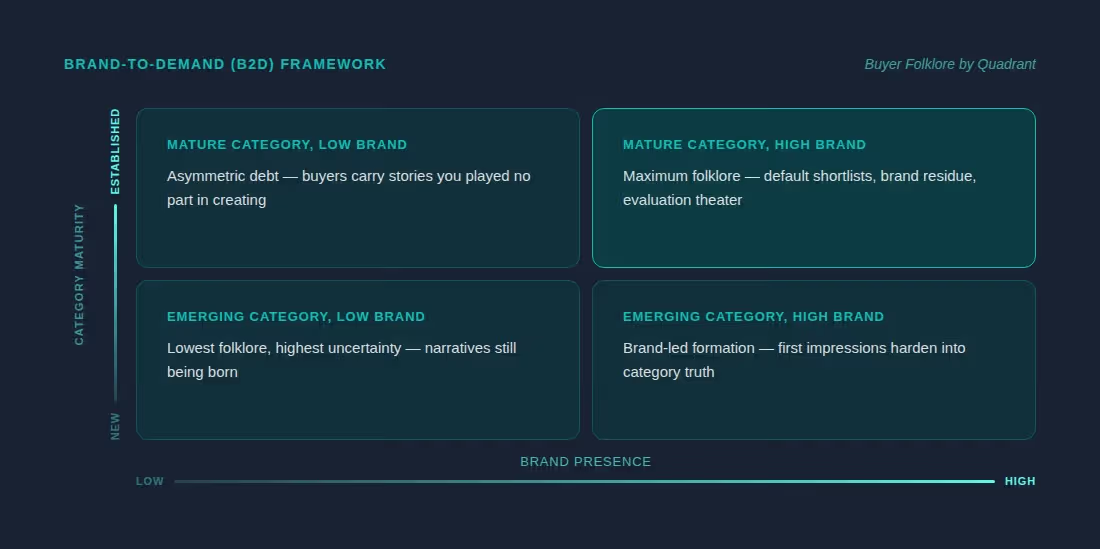
Quadrant 1: Mature Category, Low Brand
Asymmetric Folklore Debt
This is the most punishing quadrant for challenger brands.
Here, buyers bring fully formed narratives from prior roles, prior companies, and prior decisions — but that folklore was not formed in relation to you.
THE FOLKLORE
“I know everyone in this space.”
“Our safest bet is…”
“The CEO / CFO are already comfortable with…”
That folklore privileges:
- incumbents
- known quantities
- brands associated with safety, scale, and defensibility
Even when immature brands are objectively superior, they encounter skepticism that feels intuitive rather than reasoned. Process requirements, governance constraints, and selection criteria are included and weighted in a way that reinforces existing narratives.
This is asymmetric folklore debt: buyers carry stories that disadvantage vendors who played no role in creating them — the mirror image of seller-side folklore debt discussed earlier in this series.
IN PRACTICE
- entrenched competitors pre-shape requirements and decision criteria
- buying groups reuse evaluation frameworks formed through prior experience
- adventurous buyers may include new vendors on a shortlist even when there is little chance they can win
Strong demos don’t convert. Admitted preference doesn’t turn into yes. Interest stalls at “interesting.”
The buyer isn’t rejecting the product or the vendor’s claims. They’re peremptorily excluded.
DEALING WITH BUYING FOLKLORE IN QUADRANT TWO
The challenge for challenger brands in this quadrant is not invisibility — it’s narrative disadvantage. Buyers aren’t ignoring you; they’re evaluating you through a lens shaped by someone else’s story. The goal is to understand that lens and work with it, not around it.
GATHER INTELLIGENCE
- Conduct win/loss interviews focused specifically on how buyers described the competitive set at the start of the journey — who was on the Day 1 shortlist and why
- Interview sellers about the objections they encounter earliest in the process — these often reflect inherited narratives rather than product evaluation
- Survey prospects and customers about their prior experience with the category and with incumbent brands — what stories do they carry, and from where?
- Engage analysts and consultants to understand how they describe your brand relative to established players — their narratives often seed buyer folklore before sellers ever engage
- Monitor social channels (e.g., LinkedIn, Reddit) where real prospects and customers discuss vendors, listen for how the competitive set is positioned
IDENTIFY THE SPECIFIC FOLKLORE WORKING AGAINST YOU
- Map the most common narrative frames buyers use — procurement requirements, governance constraints, risk aversion — and trace them to their likely origin (prior implementations, industry conventional wisdom, peer influence)
- Distinguish between folklore that is about the category (which you can sometimes reframe) and folklore that is about specific incumbents (which is harder to displace directly)
DEVELOP A COUNTER-NARRATIVE STRATEGY
- Don’t fight the incumbent’s story on its own terms — reframe the decision criteria so that your strengths become the relevant ones
- Build reference stories that directly address the most common folklore objections, with specificity about conditions, outcomes, and mechanisms
- Use third-party validation — analysts, practitioners, peer communities — to introduce your narrative into the channels where buyer folklore forms and travels
Quadrant 2: Mature Category, High Brand
Maximum Buyer Folklore — for Better or Worse
In many B2B solution categories, both the category and the vendors within the categories are mature and well known to all or nearly all buyers.
This is the quadrant most people implicitly mean when they talk about “enterprise buying.” Buyers here have bought in these categories before — many times. They have implemented, renewed, expanded, regretted, defended, and sometimes unwound prior decisions. They carry scars. They’ve survived post-mortems. In some cases, they’ve built reputations — even careers — on having made the right choice.
THE FOLKLORE
“[This category] is table stakes.”
“I come from mostly X shops.”
“I’ve always had good experience with…”
That folklore shows up as:
- default shortlists
- mandated inclusions (“we have to include Vendor X”)
- evaluation rituals that appear rigorous
- skipped or compressed buying-journey steps
This folklore is rarely irrational. It is career-protective — the buyer-side analog of seller folklore that once enabled speed and confidence under uncertainty.
WHERE FOLKLORE BECOMES DEBT
The danger, however, is that buyer folklore becomes predisposition without timestamp.
Mature brands enjoy a substantial advantage in being included on the Day-1 shortlist. Brands with the highest market share are almost certain to be early contenders.
However, established brands are also especially exposed to negative folklore debt — what might be called negative brand residue:
- painful past implementations
- legacy pricing or contract friction
- outdated product perceptions
- secondhand stories that persist long after conditions have changed
Buyers that only consume information about brands casually between buying cycles often struggle to distinguish between what a brand was, and what a brand is now. And their deep experience in a category may lead them to overrate their current understanding of the competitive landscape.
As a result:
- true consideration never happens
- evaluation is quietly pre-biased
- sellers are asked to overcome ghosts
In practical terms, vendor selection happens before sellers engage — but the folklore shaping a brand’s chances of winning can be positive or negative.
Mature brands may be advantaged by folklore. They may also be constrained by it.
DEALING WITH BUYING FOLKLORE IN QUADRANT ONE
The means for understanding and responding to buyer folklore for providers in this category are well known and straightforward:
GATHER INTELLIGENCE
- Conduct interviews with buyers who recently chose a competitor, focusing on their perspective and prior experience with the brand and its solutions
- Survey audiences of potential buyers to probe brand and solution impressions and attitudes
- Interview sellers to understand what they are hearing from customers
- Interview important category analysts and consultants to understand the narratives they hold concerning the brand and its solutions
IDENTIFY & RESPOND
- Assess data captured to identify folklore debt, both positive and negative
- Identify audience narratives about the brand and its solutions
- Assess means to counter negative folklore debt
Quadrant 3: Emerging Category, Low Brand
Low Folklore, High Uncertainty
This is the least folklore-constrained — and most fluid — quadrant. The absence of pre-existing buyer narratives makes it the most receptive to new brands. At the same time, it makes purchasing the least likely.
Buyers here:
- lack settled expectations
- are open to sensemaking
- are forming narratives rather than defending them
THE FOLKLORE
Folklore exists here, but it is indirect and lightly held:
- organizations and individuals who see themselves as leading-edge or risk-tolerant are the earliest adopters
- narratives often operate one level above the category, based on prior experiences with other new categories
In B2D terms, third-party validation — analysts, journalists, investors — is often required to make the category feel real.
This is where folklore debt is born quietly, before anyone realizes it exists.
DEALING WITH BUYING FOLKLORE IN QUADRANT FOUR
In this quadrant, the folklore problem is not correction — it’s construction. Buyers have no settled narratives about your category or your brand, which means they are yet to be formed from whatever inputs reach them first. The organization that shapes those early narratives has an outsized and durable advantage.
GATHER INTELLIGENCE
- Monitor how analysts, journalists, and investors are characterizing the emerging category — their framing often becomes the one buyers adopt
- Interview early adopters about how they explained the purchase decision internally — the language they used to justify it is the beginning of the category folklore
- Talk to prospects who chose not to purchase about what they told themselves about not buying yet — these are the narrative gaps that need to be filled
- Interview sellers about the questions buyers ask earliest — these reveal the analogies and reference points buyers are using to make sense of something new
IDENTIFY THE NASCENT NARRATIVES FORMING AROUND YOU
- Map the metaphors and analogies buyers use to describe what you do — these are proto-folklore, and they will harden whether you participate in shaping them or not
- Identify which adjacent categories buyers are drawing comparisons from — understanding this tells you which inherited narratives you’re already competing with
- Where competitors exist, also celebrate narratives from their customers — your buyers will feel safer knowing you are not the only provider that perceives the problem and can address it
SHAPE THE FOLKLORE BEFORE IT SHAPES YOU
- Build relationships with the third parties — analysts, practitioners, investors — whose narratives buyers will lean on to make the category feel real and the purchase feel safe
- Invest heavily in category definition — the stories you tell now about what the category is, who it’s for, and what success looks like will become the reference points future buyers use
- Make your earliest customer stories as specific and transferable as possible — they are not just testimonials, they are the founding mythology of the category
- Design your sales motion to propagate positive narratives about the category — it’s less about describing capabilities and more about establishing category success narratives
Quadrant 4: Emerging Category, High Brand
Brand-Led Folklore Formation
Buyers lack category experience, so they lean heavily on mature brands and trusted third parties — analysts, consultants, journalists — to supply:
- category legitimacy
- functional boundaries
- definitions of “good”
Buyers often have pre-existing relationships with sellers inside mature brands. Their first exposure to a new category may come through those relationships, subtly positioning the mature brand as a default category leader.
THE FOLKLORE
“I’ve noticed that X is talking about a Y platform — should we take a look?”
Mature brands help create buyer folklore here:
- early use cases become canonical
- early buyer experiences become reference points
- early buying rituals harden quickly
Through existing relationships and market influence, mature brands can prompt buyers to explore a new category. They are not creating demand, but they are able to direct attention.
What buyers learn first often lasts longest, even as the category evolves.
This is how today’s clarity becomes tomorrow’s folklore debt — stories formed early, then carried forward long after conditions change.
DEALING WITH BUYING FOLKLORE IN QUADRANT THREE
In this quadrant, mature brands face a different kind of folklore problem: the narratives working against them are ones they helped create. Early use cases, early buyer experiences, and early category definitions harden into reference points that buyers carry forward — even as the product, the category, and the competitive set have evolved.
GATHER INTELLIGENCE
- Interview buyers who engaged but did not purchase, focusing on what they believed about the category coming in — and where those beliefs came from
- Survey buyers and prospects about their understanding of what the category does and who leads it — outdated perceptions are often the obstacle, not product fit
- Engage analysts who cover the category to understand how they are characterizing it. If no analysts cover it, lobby analysts in your existing categories to cover it
- Interview sellers about the assumptions buyers arrive with — particularly assumptions that reflect an earlier version of the product or use case
IDENTIFY WHERE BUYER FOLKLORE IS WORKING AGAINST YOU
- Map the gap between how prospective buyers discuss the category entry points, identifying the narratives that minimize the need for the category (e.g., “We were able to address that with hires”)
- Identify the buyer personas and organizational contexts where new category success narratives are most relevant
- Assess whether your own early-success narratives do not address current buyer needs — focus them instead on new category success narratives
MANAGE THE NARRATIVE TRANSITION
- Explicitly retire or reframe early success stories that no longer represent the primary value your audience has identified
- Invest in new reference stories that reflect current capabilities and current buyer contexts, not founding-era wins
- Work with analysts and category influencers to update how the category itself is narrated — as the category early-mover, you have more leverage here than any other player
The Pattern Across Quadrants
Across all four quadrants, the same mechanism operates:
– stories reduce uncertainty
– stories provide success narratives buyers can easily remember and retell
– stories allow prospective buyers to relate to existing customers
– stories persist longer than conditions
Folklore debt is not evenly distributed.
It concentrates where buyers have the most experience and the most to lose — precisely the same dynamic observed on the seller side.
Buyer folklore debt isn’t about ignorance.
It’s about memory without timestamps.
When seller folklore and buyer folklore align, they reinforce one another — even when both are wrong.
Part IV: Achieving Narrative Hygiene
In the first three installments of this series, we introduced the concept of folklore debt, explored how it constrains go-to-market teams, and examined how buyer folklore shapes — and often distorts — B2B decisions.
This final installment is about practice.
If folklore debt accumulates when stories outlive the conditions that made them useful, then managing folklore debt means:
- recognizing when current mythologies should no longer inform how an organization operates, and
- crafting new narratives that align better with current conditions and goals.
We call this operationalizing narrative hygiene.
Narrative hygiene is not about erasing stories, challenging culture, or suppressing history — that point bears repeating, because it is often misunderstood. It is about ensuring that the stories organizations rely on remain contextual, time-bound, and open to revision.
Why Narrative Hygiene Needs to Be Operational
Most organizations already believe they are data-driven. Many regularly revisit strategy, review performance, and refresh plans.
Yet folklore debt persists.
That’s because folklore does not live in strategy decks or dashboards. It lives in:
- how problems are framed
- which explanations feel intuitively correct
- what evidence is considered relevant
- which questions never get asked
Left unmanaged, folklore becomes ambient truth — shaping decisions without ever being examined.
Narrative hygiene works only when it is operational: embedded in existing planning, measurement, and decision-making rhythms, rather than treated as an occasional reflection exercise.
The Narrative Hygiene Loop
At its core, operationalizing narrative hygiene is a simple loop, repeated regularly as the organization evolves:
- Name the phase/ era
- Label the stories
- Test narrative fit and mechanisms
- Update, scope, or retire narratives
- Institutionalize learning
None of these steps are complex. Their power comes from repetition.
Scoping the Narratives: How Stories Are Identified and Situated in Company Folklore
Step 1: Name the Eras
Folklore becomes debt when stories outlive the context in which they formed.
The first act of narrative hygiene is therefore temporal: explicitly naming the eras of the company’s evolution, beginning with a retrospective on prior eras.
Examples might include:
- The Founding Era
- Early Traction
- Riding the Rocketship
- Hypergrowth
- Steady Growth
- Portfolio Expansion
- Efficiency and Optimization
The specific labels should signal something important to the company’s history, but the labels matter less than the act of labeling itself.
By naming eras, organizations acknowledge simple but powerful truths about the company’s lifecycle:
- the organization experienced a period that is now over (or likely to end soon)
- a new era has begun (or will soon)
- what worked then may not work now
- what is working now, may not work in the future
This immediately weakens the tendency to treat past success as timeless instruction.
Step 2: Label the Stories
Once eras are named, the next step is to explicitly identify the stories that represent the major themes within each phase.
These often surface quickly:
- “This is about how we got from zero to $10M”
- “This is about when inbound really took off.”
- “That’s about what got us to unicorn status.”
- “That’s about how Person A instilled operational discipline that goosed EBITDA.”
The goal is not to debate whether these stories are perfect descriptors of the era in question. The goal is simply to identify the stories that already exist, and to bind them to the phase in which they arose.
Language matters here. Simply referring to something as “our early MQL era” or “our founder-led growth phase” subtly reframes the period for employees.
Stories don’t lose power when they are labeled. They lose unearned authority over what happens next.
Step 3: Test Narrative Fit & Coherence
Folklore debt thrives on misattribution — confusing unrelated activities and happenings with what actually caused results.
Narrative hygiene requires a disciplined separation of:
- outcomes (what happened)
- mechanisms (why it happened)
Before moving on, it’s a good idea to pressure test narrative scoping with select members of the functions touched by the narratives.
Questions to ask:
- Do this narrative ring true?
- Under what conditions did it work?
- What would have happened without it?
- What changed that prevented it from continuing to breed success?
- What assumptions must be true for it to work again?
Importantly, this step is not about proving folklore wrong. It is about discovering where it still applies — and where it no longer does.
Step 4: Ongoing Narrative Hygiene
Once mechanisms are in place, definition of current folklore (the eras and their narratives) should be periodically reviewed.
There are only three legitimate outcomes for any piece of folklore:
- Still valid — the conditions largely persist
- Partially valid — the story applies, but in narrower contexts
- Expired — the conditions no longer exist
To make this concrete, the table below illustrates how common GTM folklore can land in each category as conditions change:
Most folklore does not need to be destroyed. It needs to be labeled and assigned to an era — or even to a specific situation within an era.
For example, a founder story may still matter for SMB deals, but not for enterprise motions.
Likewise, an MQL story may still matter for a company’s entry-level options, but not for the motions it plans to scale into larger accounts. A cold-call prospecting archetype may still fit a named-account model, but not broad market penetration.
Narrative hygiene is the practice of keeping these scopes explicit.
Step 5: Institutionalize Learning
The final step is about embedding narrative hygiene across core organizational practices.
If narrative hygiene depends on heroic leaders, courageous truth-tellers, or occasional offsites, it will fail.
To persist, narrative hygiene must be embedded into existing systems:
- quarterly business reviews
- revenue planning cycles
- tool evaluations
- hiring and enablement
- post-mortems and retrospectives
The question to normalize is simple. As solutions are proposed for current business plans and challenges, ask:
- Which narrative are we relying on here?
- When that question becomes routine, folklore debt stops compounding.
Who owns narrative hygiene?
For it to work, this discipline must be embedded in the rhythms of GTM execution — not outsourced to strategy decks or thought-leadership pieces.
Responsibility should be distributed across:
- Revenue Operations, which can surface pattern drift and signal distortion
- Product Marketing, which often curates narratives for internal and external alignment
- Sales Enablement, which translates narratives into motion
- Executive Sponsors, who legitimize revision and model adaptive belief systems
Make folklore review part of QBRs, planning offsites, enablement updates, and win/loss interviews. The work is light — but only if it’s regular.
Narrative Hygiene Across the Buy–Sell Boundary
One final implication matters.
Seller folklore and buyer folklore interact.
Seller stories shape how markets are approached. Buyer stories shape how offers are evaluated. When both sides rely on outdated narratives, they reinforce one another — even when neither reflects present reality.
When Buyer & Seller Narratives Collide – A Parable
But now, deals aren’t closing. Conversion from MQL to SQL is down sharply.
Sid knows what the issue is, or thinks he does. The sales team isn’t following up fast enough. Conversion rates are down because reps aren’t working the leads properly. He’s seen this before — great top of funnel, broken middle. He pushes for better SLAs on MQL follow-up. Response time drops from 4 hours to 47 minutes. Conversions improve somewhat but late-stage pipeline doesn’t move.
What Sid doesn’t know is that Nancy exists. Many Nancies.
Nancy is a VP of Revenue Operations at a company that would be a strong fit for Sid’s product. She has been through four buying journeys in the last six years across four companies. She knows exactly what happens when she fills out a form with her work email. She knows about the 47-minute follow-up. She’s been on the receiving end of it dozens of times — with vendors she wasn’t ready to talk to, interrupted at inopportune moments, asked qualification questions she didn’t yet have answers to or want to discuss.
So Nancy has a system. When she’s researching — genuinely learning, building a point of view, doing the kind of reading that Sid’s content team works hard to produce, she has a process she’s carried with her for years across multiple companies.
In Nancy’s organizations, they don’t fill in forms. They joke about it in meetings, swapping stories about how they work around vendor web forms.
Instead, she has a staff-member use a fictitious company domain email address to fill in forms where necessary. Otherwise, they simply consume content anonymously.
When Nancy’s team is ready to buy, a designated staff member puts her work email into a form. Or calls. Or asks people they know at the vendors who they should talk to.
Sid’s system doesn’t see most of Nancy’s research. What it sees is form fills. It sees the hundreds of Nancies who use fake emails or simply never respond because they aren’t in market or interested in engaging. Occasionally, he sees the form fill from a buyer that has completed most of their evaluation and is ready to talk.
In quarterly reviews, Sid focuses on those MQLs that converted to pipeline. Which campaigns did they come from? Which BDRs got them and what techniques were they using?
His MQL volume is real. His conversion problem is also real, because his team chases buyers who are mostly non-responsive.
Nancy, meanwhile, has just completed her evaluation of three vendors. She chose one of them. It wasn’t Sid’s company. They made her shortlist — she liked the content, actually — but by the time Sid’s system received the legitimate form-fill her choice had been made.
Sid plans next quarter’s content calendar based on his MQL conversion study, and gets his team excited about what is to come with a story about the campaign that reeled Nancy in.
From Stories to Learning Systems
Company folklore is inevitable. It is human. The narratives we repeat about our organizations shapes the culture, shapes how decisions are made.
But organizations that mistake stories for core operating principles eventually lose their ability to adapt.
- The most resilient B2B organizations neither lock their folklore into place nor eliminate it.
- They manage it.
- They treat narratives as lenses through which to understand the development of the organization. They allow the company’s identity to evolve with its folklore.
- That is what operationalizing narrative hygiene really means.
- Not abandoning the past.
- But taking control over the narratives we live with to drive the best outcomes in the present and the future.